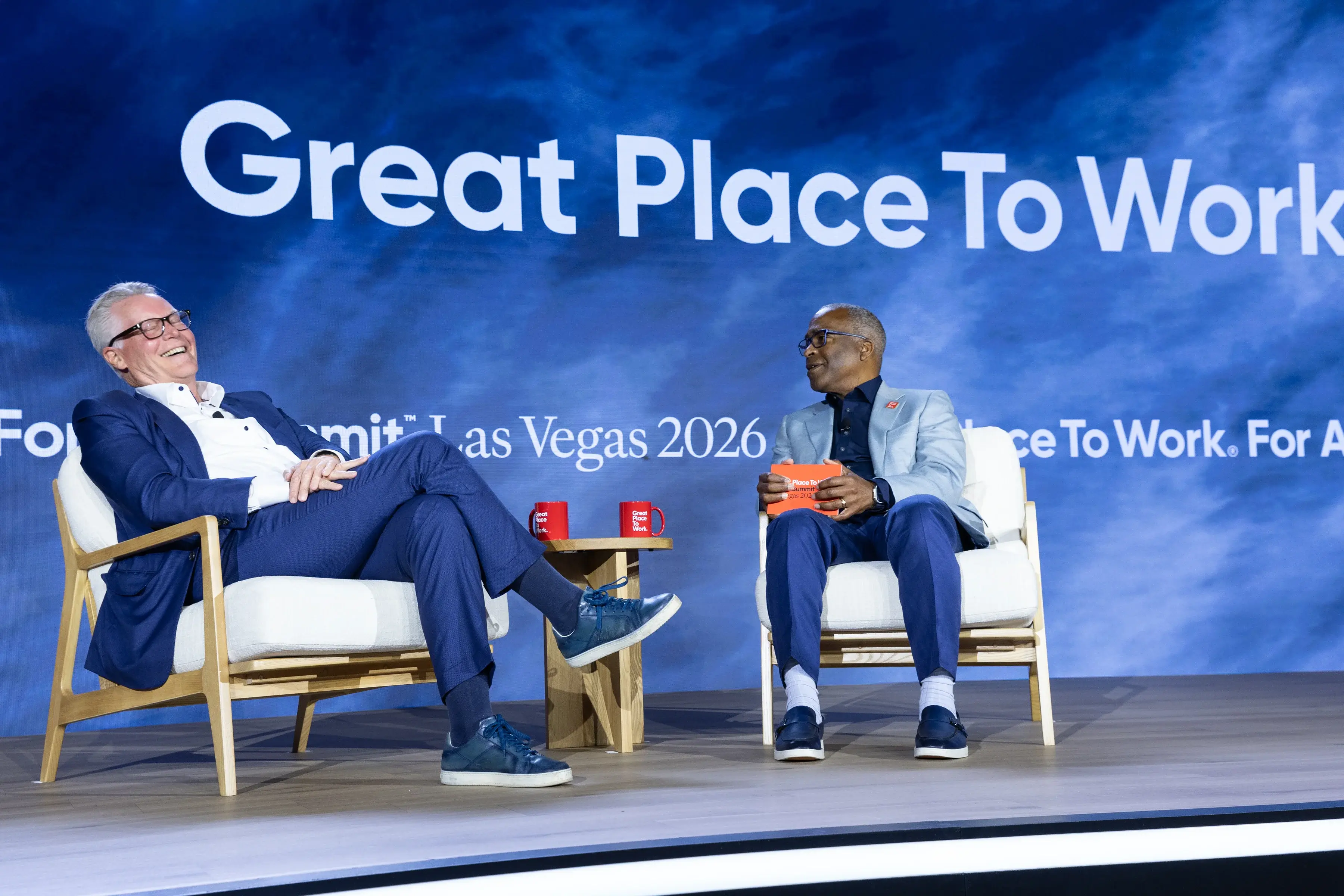



Leaders from many of the world's top-performing companies recently gathered in Las Vegas for the Great Place To Work For All Summit™ and, where Global CEO Michael C. Bush reminded us of the power of hope, and what it can do for people and organisations:
"Without growth, there is no hope. And without hope, there is no growth. We have to spread hope for all," Michael said.
What also struck us was how many leaders on stage said, without hesitation, that leading people through uncertainty isn't a burden, but a privilege.
Delta Air Lines CEO Ed Bastian, for example, lost his mother in the early days of COVID; watched his company's revenue rapidly sink to zero, and still showed up every day for their 90,000 people.
"The chair I was sitting in was the most important chair anyone could sit in. It wasn't a burden placed on me. It's a privilege. It's a blessing," Ed said.
Top takeaways for leaders:
1. People-first is not a “soft” strategy. It's the only strategy.
"The only thing in an airline industry you cannot replicate are the people and the culture you create, and that’s why Delta’s No. 1," Bastian said. During COVID, Delta avoided mass layoffs with over 50,000 employees voluntarily taking unpaid leave to save their colleagues' jobs. That can only happen with deep trust.
Now more than ever, people look to their leaders. It is an obligation of every leader today to create trust and hope.
2. Culture is never “done” — treat it like ongoing operations.
Chris Nassetta, CEO of Hilton (currently the No. 1 World's Best Workplace™) said it plainly:
"Building culture is never-ending. But it is the secret sauce."
When COVID hit and the hospitality giant went from UDS$50 billion in revenue to zero overnight, it was a surplus of trust — built over years — that carried them through and ensured they came out of the crisis stronger.
3. The situation you create is everything.
Angela Duckworth, author of Grit, says success isn’t only about pushing harder. It also depends on being in the right setting.
"When you are in a better situation — more challenging, more supportive — that leads you to have more positive, optimistic thoughts," she said. "That brings out a level of effort you didn't think was possible. And that higher performance puts you in even better situations. It creates exponential growth."
That idea is at the centre of her new book, Situated: Find the People and Places That Bring Out Your Best” scheduled for release in September 2026.
Angela emphasised that people thrive when the surrounding context helps them to succeed – and the Great Place To Work Effect shows that this is just as true for organisations as it is for individuals:
-
Great workplaces create the conditions for people to do their best work, not just their assigned work.
-
When people feel trusted, supported, and valued, they are more willing to go above and beyond.
-
High-trust cultures reduce friction and remove barriers that slow people down – because when employees can focus on doing great work, they are more likely to innovate, solve problems, and adapt quickly.
-
Better situations bring out better behaviour: more initiative, more resilience, and more consistent effort.
4. Great leadership is key to AI adoption.
Accenture CEO Julie Sweet framed AI not as a technology challenge, but as a leadership one.
In her conversations with CEOs around the world, Julie said the focus has shifted to resilience — and specifically to how leaders help employees navigate change without fear. Helping employees “make the journey on AI,” she explained, requires leaders to focus as much on confidence and trust as on tools.
As leaders rush to adopt AI, the real test is whether employees feel supported along the way. “I believe that as long as CEOs of companies are asking a question, 'How do I make sure that in this world and these changes with AI — that my people are going to be okay?' and that's the conversation. I am fundamentally optimistic that we will make sure that people are okay."
Cadence CEO Anirudh Devgan reinforced the idea that AI adoption is ultimately about how employees experience change, not just how fast companies push out tools. He noted that while enthusiasm for AI is high at the leadership level, employees are often more skeptical. Closing that gap requires transparency and actively bringing people along.
5. Frontline workers deserve the spotlight.
One of the many heart-warming moments came when Bush brought frontline workers from the Summit venue — Hilton employees who kept the event running smoothly all week — onto the stage. The room stood and applauded as it became a moment we were all reminded: These are the people who keep the world running, and they deserve to be seen.
“The reality is those of us who are white collar workers, knowledge workers, if we all took tomorrow off, the world will keep spinning. If all the frontline workers took tomorrow off, it would stop. It would absolutely stop,” Bush said.


.png)

 great place to work effect