

For Erwin Rengers, Global CHRO at Hyva, "active commitment from top leadership is essential" for any company looking to develop a great culture globally. The result: year-on-year gains in engagement alongside reductions in absenteeism, turnover, and improved overall business performance.
Your career spans over 30 years in HR, working at some of the world’s largest brands, like Heinz, Steinhoff and TE Connectivity. What was the turning point or moment in your life that made you decide HR was the area of work where you want to be?
Erwin: When I was young, my ambition was not specifically to work in HR. I initially aspired to become an F16 pilot and underwent testing with the Dutch Royal Airforce. Unfortunately, after a week of assessments, I did not qualify. I then considered studying law. However, a good friend enthusiastically recommended a Human Resources Management programme, believing it would suit me well. I joined him for a day to experience his studies first-hand, and I was convinced this was the right path for me. After completing my HR studies, I also earned a degree in Business Administration. Now, after more than 30 years pleasantly working in HR, I know I made the right choice.
At Hyva, you’ve been responsible for marketing as well. What do you wish more HR leaders knew about marketing and employer brand?
Erwin: A strong brand identity is essential for engaging key stakeholders, including customers, suppliers, and both current and prospective employees.
For B2B companies like Hyva, brand identity can serve as a unique selling proposition (USP) in a competitive market. The Employee Value Proposition (EVP) plays a critical role in ensuring consistency between internal culture and external brand activation, such as on social media. Drawing from my experience in listed companies and the FMCG sector, I have seen first-hand how effective communication and marketing are vital to building and maintaining a strong employer brand. With a team of marketing and digital experts, organisations can significantly strengthen their brand identity and reputation as an employer.
What initially brought you to Great Place to Work®? And how has your Trust Index™ survey data been used throughout the years to inform your People Strategy and achieve organisational goals?
Erwin: When I initiated the Great Place To Work programme at Hyva, I drew upon my previous experience with similar initiatives. In my view, Great Place To Work helps organisations better balance the required soft skills by providing actionable data from confidential employee surveys. This data enables us to identify areas for improvement and set clear priorities.
We categorised follow-up actions into two groups: short-term 'quick wins' for people leaders to implement within their teams, and longer-term strategies led primarily by the global HR team. Crucially, the Great Place To Work initiative received full support from the CEO and Management Team, which was a precondition for me to proceed. To emphasise the importance of the initiative, annual Great Place To Work targets were linked to performance indicators for the entire Management Team and senior people leaders.
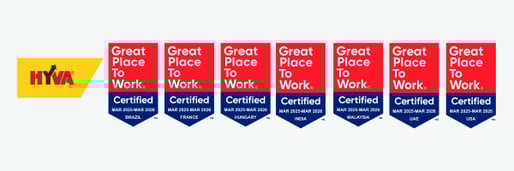
Being Certified™ 'great' in seven countries is a fantastic achievement! What does Certification™ mean to you, and how has this accreditation influenced your global employer brand?
Erwin: Achieving Great Place To Work Certification has a significant positive impact on our local teams, boosting morale and fostering a sense of accomplishment. Teams and countries received recognition letters from the CEO, and are given special attention during our periodic global Town Halls. Of course, we also leverage the Great Place To Work Certification in both internal and external communications, strengthening our Employee Value Proposition and brand identity in the local labour markets in which we operate. This is one of the key benefits of being Certified.
Nearly two-thirds of your workforce have remained with Hyva for over six years. What practices have helped you to foster such long-term commitment?
Erwin: Hyva began its successful journey more than 45 years ago, and has since become a truly international company, active in more 100 counties and operating in more than 35 countries, across all continents with approximately 3,500 highly collaborative employees.
One of our key assets is the delivery of high-quality, reliable hydraulic front-end cylinders. Many of our business leaders are true entrepreneurs who have built the company over time. Innovation is central to our success, and our employees are empowered to take initiative, which has fostered pride in our collective achievements. Our global HR team, including experts and HR Business Partners, supports leaders through standardised processes and actionable plans, ensuring effective global follow-up on our Great Place To Work initiatives.
How did you communicate the value of culture and Certification™ to other senior stakeholders who may not have fully recognised or understood it in the same way initially? Has their perspective changed since then?
Erwin: Leadership is fundamental in any organisation, especially as younger generations join the workforce. The way we act, behave, and operate with each other, our customers, and stakeholders defines our culture and shapes our brand identity. Trust is the cornerstone of everything we say and do. When we began our journey to become a Certified great workplace, securing commitment from top leadership was critical.
From the outset, the leadership team became ambassadors for our culture, actively engaging and best practice sharing as they recognised that pursuing Great Place To Work status would also improve business results. HR Business Partners supported leaders throughout this process.
As a result, employee engagement improved year over year, absenteeism decreased, turnover dropped, and overall business performance increased.
Hyva has made outstanding improvements particularly around management and leadership. What advice would you give to other organisations looking to improve in these areas?
Erwin: Commitment and active participation from top leadership is crucial. The next step is to ensure that all leaders and employees are enthusiastic about embarking on this journey.
This enthusiasm is reflected in our consistently high survey participation rates, which have remained around 95% year over year. Recognising that “time is the currency of care”, we invested heavily in communication. Through leadership training, we equipped our leaders to foster engagement, and we intensified and institutionalised communication using a full mix of channels: global town halls with online “slido”-supported Q&A sessions, intranet updates, written communications, announcements, business results presentations, including Great Place To Work best practice sharing, and both global and local team meetings, as well as skip-level meetings and one-on-one discussions.
Leaders collaborated with their teams on short-term improvement activities, while employees were also empowered to take responsibility for ongoing initiatives. The global HR team provided support for these strategies and initiatives.
How have you seen Hyva’s leadership strategy contribute to improved employee engagement and business performance?
Erwin: From the outset, the leadership team acted as ambassadors for the Great Place To Work initiative. As they recognised that striving for this ambition could also improve business results, their active engagement increased.
What's been the most rewarding part of leading cultural transformation at Hyva? And any advice for other HR leaders striving to link culture with performance?
Erwin: Active commitment from top leadership is essential for a successful culture transformation. Leaders should champion these efforts with enthusiasm and persistence, addressing challenges as they arise. Open, transparent communication at every stage fosters trust and engagement. Finally, most rewarding is that such leadership not only drives results but also provides the satisfaction of seeing positive change take root.

 Case Studies