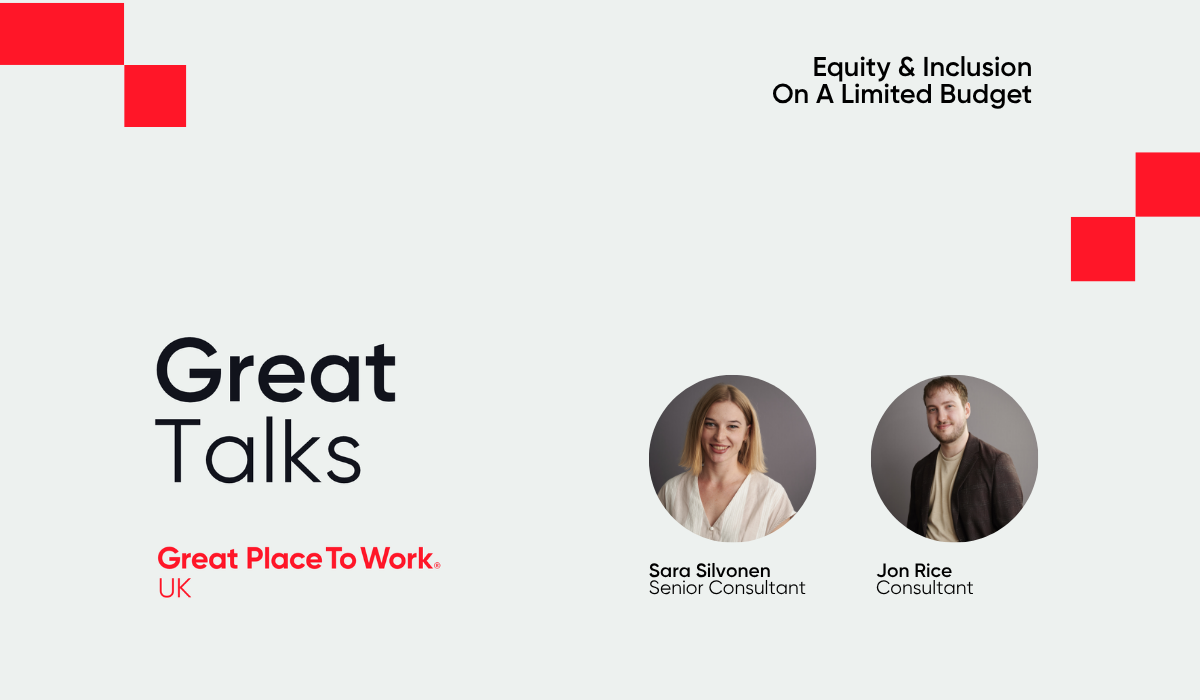



Join us as we discuss practical strategies and insights on how to foster equity and inclusion without breaking the bank.
Listen to our previous episode, Employee Development On A Limited Budget, here.
We know that many organisations share a common challenge: how to build and sustain a great company culture without the need for major financial investment.
But we believe every workplace, no matter their size or budget, can become a great place to work. In our podcast series, On A Limited Budget, we share tips and insights on how even the most budget-conscious businesses can create a healthy, happy, and productive workforce
In our third episode, we're exploring one key element of this critical challenge: fostering equity and inclusion without breaking the bank. Listen below as Great Place To Work UK Senior Consultant and Wellbeing Lead Sara Silvonen and Consultant Jon Rice dive into ways you can embrace diversity, empower people managers and build inclusive hiring practices.

Key Takeaways
1. Small actions can make a big impact
The most powerful E&I practices often cost nothing. As Jon shared, embedding inclusion prompts into 1:1s and PDPs, encouraging managers to ask the right questions, and creating space for open conversations all help employees feel supported and valued.
These simple behaviours – active listening, reducing assumptions, and tailoring support to individual needs – can transform the employee experience. When people feel heard and understood, engagement rises, trust strengthens, and performance improves. None of this requires a large investment – just consistent, intentional behaviour.
2. Trust breeds inclusion
3. Start early, evolve often
But inclusion must continue throughout the employee journey. Regular check‑ins and open conversations help organisations adapt support as employees’ needs change over time. Practical actions like rotating meeting facilitators, discouraging interruptions, or enabling flexible working empower managers to create environments where all team members can thrive.
These adjustments cost little, but their impact is lasting.
Transcript
[James]
Hello and welcome to On a Limited Budget, the podcast series where we explore how you can build a thriving workplace culture without breaking the bank. I'm James, List and Organisational Trends Manager at Great Place to Work UK and I'll be your host.
Great Place to Work is the global authority on workplace culture. Every year we get direct feedback from over 10 million employees around the world working across a range of companies in various industries and sizes, telling us how they really feel about their employer. Diving into the data, we noticed that many organisations share a common challenge: how to build and sustain a great company culture in a way that's cost effective but still impactful. Today we're exploring one key element of this critical challenge: fostering equity and inclusion on a limited budget. This means building a culture that enables all employees no matter who they are or what they do to thrive.
I'm joined today by Senior Consultant Sara Silvonen and Consultant Jon Rice. During our conversation you'll hear Sara and Jon share some practical strategies and insights on how to embrace diversity, empower managers and build inclusive hiring practices.
Join us as we explore equity and inclusion on a limited budget and discover how even the most budget-conscious businesses can ensure they're building a workplace that's great for all.
So Jon, as our resident expert when it comes to diversity, equity and inclusion it would be really good to kind of set the scene initially just so we're all on the same page on how we define it at Great Place to Work. So could you just start off just by sharing how do we at Great Place to Work define equity and inclusion?
[Jon]
Of course. So equity, often confused with equality, but equality is about treating everyone the same regardless of who they are. Equity however is about treating everyone fairly and acknowledging that people are different and might have different needs.
So in terms of the workplace you're assigning resources so everyone's sort of at a similar level. So some people might need more help than others to bring everyone to the same level of performance or even just presence in an organisation. And then inclusion is more of a behaviour.
So by creating that equity in your workplace and ensuring that employees have a similar day-to-day experience regardless of who they are within your organisation, you create these feelings of inclusion. And inclusion can be both big and small actions. They can be little small things that sort of build daily to make people feel more included or it could be big sweeping processes or interventions that are brought into the organisation.
[Sara]
Yeah I was listening to one of our clients talking about this yesterday and they said something like diversity is about stats and numbers but equity and inclusion are a choice. They need to be actively sort of demonstrated through not just policies and programs but behaviours and actions and in the day-to-day. And equity and inclusion are really fundamentally at the heart of our For All model at Great Place To Work and our survey structure which is whereby we want to make sure that all of the organisations that we work with create this great employee experience for everybody no matter who you are, your age, your gender, your managerial level, your tenure, what you do for the organisation, your role and that's why the demographics in our surveys are so important that we can identify and address these gaps.
[James]
Absolutely wonderful and I think it's really important that you started off just by explaining the difference between equity and equality because I often think there was that misconception of thinking the two are exactly the same and misconstruing both of them. But then also actually how you went on to talk about how it's important to have great experiences for your employees in the workplace and how equity and is an important part of that process and I think that really nicely leads into my next question which is if you could share with us why is equity and inclusion such an important part of workplace culture?
[Jon]
So how I always start these conversations is kind of saying that firstly it's just the decent moral thing to do like everyone deserves to feel welcome and supported in their place of work and also if people are feeling unsafe, excluded, not cared about you're not going to be getting their best work so there is as well as that moral case there is the business case as well. So by ensuring that equity and inclusion are upheld within your organisation you will likely find higher levels of engagement as employees feel included, valued and cared about and this leads on to things like higher retention rates as well. By having that culture of inclusion you're not just improving the lives of your current employees but you're attracting the best talent as well. E&I also often breathes stronger cultures of innovation as well. Inclusive workplaces encourage employees to contribute their ideas freely and have that key employee voice whilst also valuing and leveraging everyone's unique life experiences and previous work experience as well and this includes diversity of thought and this generates new products and services and can let you even access previously untapped client or customer pools as well. So there's many business cases to equity and inclusion but it really comes down to kind of treating people right is the best way to get their best out of them.
[James]
No absolutely and of course I think for all organisations we really want people to feel at their best so that they can be at their best and it's so important to catch it and realise how doing these sort of different elements will contribute to better retention and attraction but also motivation for employees to contribute and to be part of the organisation, be innovative and creative and contribute which is really important. I often think when it comes to creating workplace culture something that a lot of senior leaders are concerned about and worried is having the resources to be able to create a great workplace and often people believe that means you have to have a large budget and a lot of monetary support in order to be able to create this, but of course as an organisation we work with small to large organisations, also across industries, who have proven time and time again that you do not need to have these massive budgets to be able to create these workplace cultures. So leading into my next question what would be really good to know is a little bit more about how could you ensure your workplace culture is equitable and inclusive and can you share any examples of how clients have done this on a limited budget?
[Jon]
Absolutely so the biggest most impactful thing that a lot of our high performing clients do is simply just remember to ask employees how they're doing. They embed E&I check-ins as part of one-to-one processes and as a part of PDP conversations as well. A lot of organisations generally tend to ask these things just at kind of the onboarding stage but situations can change and will change throughout the employee's life cycle whether it to be with their physical health or their mental health, caring responsibilities or dietary restrictions.
These things can all change quickly and employees may be hesitant to start these conversations by themselves so by having it sort of built in to your talent management processes it really gives them that opportunity to share their voice in a sort of safe space and tell you when they might need extra help. As well as embedding these conversations within processes there are some other smaller fun things that our clients do as well. One thing that I've seen a few times is in these organisations with high trust environments and they invite their employees to do short presentations or lunch and learns on topics close to them such as their religious holidays, cultural practices or their experience living with a disability.
Obviously employees must be comfortable and willing to share these things, you can't force this so that sort of high trust environment coming first is very important and pertinent to that. Some of our clients even take this one step further and have human libraries where colleagues can check out their colleagues like a book and have those conversations about their lived experiences when they sort of need it for their work but also when they just want to get to know someone better.
[Sara]
I actually remember doing something like this internally a few years back at a virtual Christmas party of ours. We all shared how we celebrate Christmas or the holidays whatever that might be in our respective cultures and it was a really interesting and insightful session. I think the clue is in what you said Jon, in high trust environments you can invite people to share these things and that's what it really comes down to because I think when it comes to these quite charged topics I appreciate that some people might feel, because I sometimes feel like this too, that they're quite intimidating to approach.
They're very sensitive, there's a huge fear of saying something wrong with cancel culture and whatnot. Whether that's a real or a paranoid perception the outcome is the same and that's not really good psychological safety is it. So I think a big part of it is just breeding this culture of openness and letting go of that fear of maybe saying the wrong thing because in a high trust environment like you keep saying you'll just get corrected and you'll be all the wiser.
So awareness and education are really important absolutely but they're quite passive in a way so a lot of it just needs to be then applied in conversation and in sort of everyday behavior. You need to get people actively involved in these kinds of conversations about equity and inclusion. So the real question is how do you build that culture in the most effective way and that goes hand in hand with building psychological safety and wellbeing and all these sort of good management behaviors like you've said.
[Jon]
Absolutely and it really is about that high trust environment. So one thing that often gets underestimated is just how graceful people are and people are willing to recognise when someone might say something out of ignorance versus out of maliciousness and they'll be willing often if it's a comfortable environment, if they're comfortable with their colleagues, they are comfortable to kind of correct them or to just give them a little bit more information on things.
But one key word there as well I wanted to get back to is celebrations. We talked about how we celebrated Christmas that one time but celebrations are really a great way to make people feel included and celebrate what's important to either them or their colleagues and a lot of our current organisations do do this as well with small events or even just themed lunches. They make sure not to tokenise this event and treat it with the respect it deserves but many employees are happy to share how they celebrate and what they celebrate and particularly with food, something that's a universal human experience and is key to many cultures.
So you can celebrate things like a Chinese New Year by hosting a Chinese buffet, Diwali you can give Barfi or other Indian sweets or even just pretzels and sausages for Oktoberfest and things like that. You can really tap in and have people from across the organisation come together, share some food, share some drinks and just discuss why these celebrations are important and kind of widen their worldview whilst everyone's also having fun in a nice environment.
[Sara]
The way to an employee's heart is through their stomach.
[Jon]
Absolutely.
[James]
And I think it's really important what you're mentioning about how we have managers creating the space and time within these PDPs and check-ins to be asking the right questions and really trying to get to know employees on a deeper level and understand the kind of support that they need from that and actually also just making sure that employees feel comfortable to voice their opinion and to give their ideas and perspectives to make sure that the organisation can be as inclusive as possible. And I think one thing that I'd really like to build on a little bit more is talking a little bit about how not only managers but companies as a whole can be able to monitor how they're tracking when it comes to E&I to make sure that their organisation is as inclusive and equitable as possible. So I'd love to actually ask you sort of directly, how can organisations monitor and ensure they're working towards being a more equitable and inclusive workplace?
[Jon]
It's a great question. It's often something that really does need demystifying. So people kind of get all worked up on how to monitor these things when the simple answer is just ask your employees – on macro levels, on micro levels.
So the macro: use surveys like ours at Great Place To Work to track how employees feel about fairness, inclusion and whether they can be themselves at work and also monitor how stable this is over time. If you've got big changes coming up that might sort of shake up how people are feeling at work, monitor these effects on different demographics across your organisation. It's also important on those more micro levels to keep avenues open for employees to report when they're feeling exclusion or a lack of inclusion and when they have issues and make it again a core part of their one-to-one conversations with managers in the way you would about things like well-being or development.
Another great practice for this is creating a group of key stakeholders such as an inclusion ERG or a working group. These can be a huge help with tracking and empowering your inclusion strategy and making it feel like it's something employees own as well. Another thing that I really want to demystify from my point of view is don't beat yourself up by comparing your organisation to other organisations.
Inclusion is all about empowering people in creating a safe environment where everyone regardless of their demographics can flourish in their work but different areas and industries have different workforce demographics. If you are in a big city then you can expect and arguably you should have a diverse workforce, particularly ethnically, but an organisation in a small town in the English countryside for example might have little ethnic diversity and this purely may be because there isn't many sort of non-white people that live there in that small town but as long as you as sort of stakeholders can hand on heart say you're trying your hardest to act inclusively and are widening nets for talent (which I'll come back to in a moment) as far as you can there is nothing wrong with this. You work with what you get and there's nothing is truer than that when it comes to E&I so comparing your organisation to one in a different context a different location can be demotivating and unproductive. So I think, like with the conversations we spoke about earlier, give yourself some grace as well and as long as you're prioritising inclusion you're doing the right thing.
[James]
Absolutely and I think really building on that further we've seen time and time again because we've worked with thousands of different companies and we've seen how they've utilised our surveys be able to help create lasting change in the organisation to be more inclusive – using the open-ended questions to kind of see what changes they can make to ensure that people are feeling included and making sure their processes are fair and equitable – and of course ERGs are an instrumental part of being able to do that and we've seen how well organisations have been able to not only create them but utilise them within the workplace and I think ERGs are really beneficial because they're able to be utilised to kind of not only think about certain aspects of the employee life cycle but the whole employee journey itself and I think it'd be really good to kind of start at the beginning and kind of think about how equity and inclusion is a part of this. So if we were to start at the beginning of the employee's journey and the employee life cycle how can organisations install their processes such as something like recruitment or hiring are inclusive and as equitable as possible?
[Jon]
Of course so like with many things in the organisation it does start at that recruitment and selection process but flipping it around a little bit and starting with the selection process first once those CVs have started pouring in there are some tips and tricks you can do here to maintain and prioritise that inclusion. Some of these are very well known, so things like blind CVs get another employee to come in remove any demographic information from the CV such as name, age, gender etc. so you only see their work experience and their qualifications – that can be great for sort of not even giving you the wiggle room to have implicit biases come in, you kind of just have the key information you need. For assessments, having skills-based hiring practices using things like work sample tests so candidates are directly measured against tasks they'll do in the job should they be successful and also having those diverse hiring panels as well – multiple people ideally all of whom have done unconscious bias training and they make the hiring decisions and these panels are as diverse as possible, as diverse as you can make them within your organisation. A really great tip for this as well is including junior employees in the process because that has a double whammy effect of being great for their development also. Going back to recruitment in my experience this falls a bit flat if you don't ensure E&I in that recruitment process as well, so if you're fishing in the same talent pools you'll always catch the same fish – the same candidates you always do and whilst blind CVs might help those candidates it's always better to widen your net and fish in other pools as well and that's very key that as well, because no one's telling you to stop fishing in those original pools, just widen the net a bit. So some tips for this are going straight to the source – looking at university job fairs and going to more than one, having apprenticeship programs to nurture talent who may not have a degree, but my big tip is to partner with external organisations that have a common interest in helping you.
This can come in the form of specialist job boards, the diversity job network operates in the UK and they have LGBT job boards, black and minority ethnic, neurodiversity, disability, they have so many job boards that cater to specific groups of people and it can be really simple to just upload your job spec on one of those boards or all of those boards as well as just where you traditionally post your job specs as well. Doing that you've already widened that net but there are also special interest groups for example Coding Black Females who nurture talent themselves and they help black women and girls in the UK get into the tech and IT sectors.
These communities can be so powerful in helping you widen your talent pool as you have the same common goal and then there might even be opportunities to further support them in return and bolster your CSR output as well so it's always good to reach out to these organisations and see how groups that already operate in your sector can help you and you can help them in return.
[James]
I think working with other organisations is so important and I think also it's the same going back to what we were speaking about before, utilising your ERGs to actually ask people to really kind of go through the process of either trying the recruitment stages or the hiring stages trying to see are they facing any barriers within this process. I've seen with some organisations that they try and utilise those who are visually or hearing impaired to try the hiring process to kind of see actually how are you finding utilising the website, are there barriers to trying to click on different things, do you need extra support and actually using that employee feedback goes so far in terms of actually supporting changes within the workplace and making sure that anyone who's coming into the organisation who is going for the hiring recruitment process is getting that extra support because it's already been tried and tested and I think actually just reflecting on some of the things that we've already spoken about today.
One thing that we spoke about is the importance of having the correct support in place from people managers to make sure they're creating a psychologically safe environment for employees to feel like they can voice their opinions and share how they're feeling. So what I think would be really good to talk about is a little bit more about that manager aspect. So what are some steps that managers can take to foster inclusivity and how can the company support them in doing this?
[Jon]
Absolutely and going back to what I said earlier about empowering those one-to-one sessions and including E&I related questions in that, that is definitely one aspect of it but of course to be able to have those conversations managers do need to be empowered themselves. These things, like a lot of stuff in organisations, they trickle down that managerial hierarchy. One great thing for this is if budget allows inclusive leadership training – it can be so impactful for helping managers understand the impact of their behaviours, what biases they might hold and also how to overcome these and also kind of like what Sara was saying earlier to take away that guilt and really make people willing to have these conversations, willing to occasionally be a little wrong but willing to learn from that and sort of better their practices both for themselves but also for their team as well. There are some smaller things that managers can do so a lot of these are associated with behavioural change such as having team meetings, making sure everyone's voice is heard and being equitable, rotating facilitators who's hosting the meetings to get those different perspectives and discouraging interruptions as well.
Things like differing work styles can play into this as well, remote and hybrid work and kind of making sure people have that working pattern and working environment that works best for them and of course making sure people grow that confidence and being able to express their employee voice and report those possible exclusions and voicing their inclusion needs.
[Sara]
Yeah it always strikes me how much similarity there is between these topics and wellbeing, especially when it comes to people management skills. An E&I conversation basically is a wellbeing conversation and in the same vein a wellbeing conscious organisation or leader or people manager is most likely to also be an equity and inclusion conscious one. I'd say they share a lot of prerequisites: if equity and inclusion and wellbeing is the outcome that we want to see then it comes down to those really good people management skills like you've been saying, things like active listening, proactively checking in, not having a lot of assumptions, being kind and compassionate, really sort of basic things.
They're not rocket science at all but they go a really long way and that's often the best thing that the people managers can do. I guess the way that I look at it is if wellbeing is the outcome that we want everyone to achieve then equity might be a perspective on how to get there to ensure that it really applies to everybody in the organisation and one huge way of going about that like you've said is to support and empower and upskill frontline managers.
[Jon]
Absolutely, I definitely echo your sentiments there. At the end of the day like DEIB is around ensuring people's wellbeing and wellbeing doesn't work if you don't account for the differences within people so they definitely are two topics that are sort of very linked but should be increasingly married up.
[Sara]
Yeah, two sides of the same coin.
[James]
.Wonderful and based on everything we've spoken about today and your years of experience of being consultants at Great Place To Work, if you were to give people leaders one recommendation for creating an inclusive and equitable workplace on a limited budget what would it be?
[Jon]
So kind of echoing what Sara just mentioned for me is empowering those frontline managers and just employees in general to be able to lead from the bottom up when it comes to inclusion. Bake those inclusion prompts into one-to-ones and PDP conversations. Give flexibility for managers to manage their teams in ways that people need and kind of maintaining their equity and working adjustments if need to.
People are unique and thus will have unique circumstances that might need adjustments that might not have been previously considered. These things might change over time, they might need adjustments at the five-year mark that they've never needed before so having these regular check-ins ensures that exclusion doesn't creep up on you and you can kind of maintain that inclusion.
[Sara]
Yeah, so implementing all those little practices and processes that we've discussed today and Jon you've given so many amazing really tangible examples of how to do that, but I'd urge people leaders to just make sure that they have this really good understanding of all the concepts first and are comfortable discussing them and then build those practices on that foundation or on that culture in that order. Don't just do them for the sake of doing them which is tempting when you've got these big buzzwords and these big topics but to do them authentically that is crucial otherwise it might just backfire.
[James]
I think that's great and I think what you said there Jon about people are unique I think is so important that one size does not fit all approach and really making sure that we're actually listening to employees and having that space to make sure that they are feeling like they're being listened to and actions are being taken by their leaders to ensure they're creating a environment where employees can thrive and feel psychologically safe. Thank you so much Jon and Sara for sharing your insights today and thank you for taking the time to join us today, and to our listeners hopefully you've gained some helpful tips for how you can support equity and inclusion on a limited budget.
Thank you so much for tuning in, make sure you're subscribed wherever you get your podcasts and sign up to our newsletter so you get notified when our next episode is live, where we'll be talking about Belonging On A Limited Budget, and to find out more about how we can help you measure and improve your company culture visit us at greatplacetowork.co.uk




 Podcast