

Can employee benefits ever compensate for a culture people don’t trust?
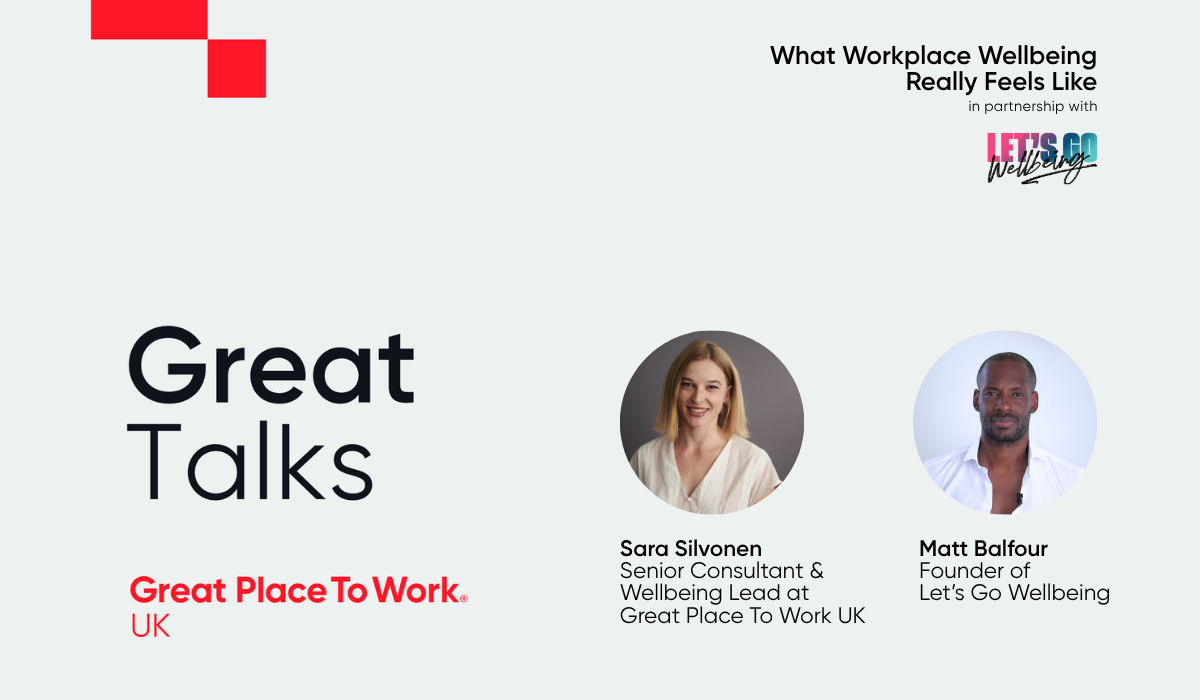
Sara Silvonen, Senior Consultant and Wellbeing Lead at Great Place To Work UK, joins Matt Baflour on the Wellbeing Talk podcast, to discuss what millions of employee experiences reveal about trust, leadership and healthy workplace culture. Watch the conversation below.

Join our For All Summit London 2026 in-person event for inspiring insights from top-performing organisations. Registration deadline: 6 November 2026.
Show Full Transcript
Matt
An organisation can offer wellbeing benefits, support services and all of the right policies, but does that necessarily mean its employees experience a healthy workplace? And what happens when two employees working for the same organisation experience very different levels of trust, care and psychological safety? In this episode of Wellbeing Talk, we're asking what does workplace wellbeing actually feel like and how can organisations tell if it's genuinely embedded in their culture?
Sara
The right things, the best things, the most fundamental things are the ones that are so integrated anyway into your workflows, relationships, processes, systems, that they don't seem to be wellness or wellbeing initiatives at all. They're just blended into the fabric of the organisation. That it's not a kind of detractor from your overall wellbeing, your life satisfaction.You're not a weekend warrior. You're not waiting for five o'clock or living for the weekends, that kind of thing.
Matt
Sure.
Sara
But that work is a fundamental contributor to your overall life satisfaction.
Matt
To help us explore these questions, I'm joined by Sarah Silverman, Senior Consultant and Wellbeing Lead at Great Place to Work UK. Drawing on the experience of millions of employees, Sarah's work explores the link between trust, leadership, wellbeing and organisational performance. Together, we'll discuss the difference between providing support and creating a culture of wellbeing.What trust looks like during an ordinary working day? Why employee experiences can vary so significantly within the same organisation? And what the evidence can genuinely tell us about wellbeing, retention and productivity?My name is Matt Balfour, founder of Let's Go Wellbeing and this is Wellbeing Talk. Sarah, thank you for joining the show. Really, really nice to meet you.
Sara
Likewise, thank you for having me.
Matt
So you're currently the Senior Consultant and Wellbeing Lead at Great Place to Work UK. Before we get into the research, I'd like to understand a little bit more about the person behind the data. With that in mind, what first led you to becoming interested in how people experience the workplace?
Sara
Yeah, I mean, I can't say it was a like a pivotal moment or anything like that, probably more of a gradual evolution. My first love or my first passion was psychology, always psychology. Probably more the abnormal clinical side of it, but also social psychology.And then over time, I just applied that more to the organisational context. I guess I felt I could maybe sort of reach more people that way. You know, most people work. It's quite a relatable thing. A lot of people have some kind of job stress, this kind of thing. So it was just quite universal, just a way I could maybe have a bit of an impact in people's day to day. And I think the other more organic influence for me was growing up a bit of a workaholic dad, watching the long hours, watching some of his stress, but in equal measure, his kind of utmost dedication to his job as a civil servant in the Euro system. So it was always interesting how that kind of dedication almost made up for or justified the social sacrifices. Whether that's good or bad is maybe a different question, but I found it interesting.
Matt
So what problem would you say you were trying to solve by kind of focusing on the psychology you mentioned? Would you say it was a case of trying to find a way to balance the self sacrifice with the with the impact that you saw from your dad's work?
Sara
Yeah, I mean, I probably wasn't consciously trying to solve a problem at the time. It was just sort of I mean, from a very young age, even I was kind of witnessing this and as a partly realizing that there's a lot of power and purpose and purpose of work. And I think that still applies today.But you know, it can't go into the sort of detrimental space where you're, you know, sacrificing things from, from other parts of your life. So I guess finding this sort of happy, happy balance, happy middle ground. Yeah, but definitely, you know, retaining that that kind of purpose.Yeah, interesting and a sustainable way, I guess.
Matt
Yeah. So when you first began working in this area, what did you believe made a healthy workplace? And how would you say that you're thinking has evolved over time?
Sara
Well, when I first started working in the field, I just come from a degree in the field. So I basically just believed the academic theories around workplace wellbeing and what that comes down to, which was positive affect. So feeling happy on the job or positive feelings, and eudaimonic wellbeing. So feeling purpose fulfillment, kind of a bigger picture, long term goals, that kind of thing. And social wellbeing relationships. And of course, I was a bit naive and had a lot to learn about, you know, what actually goes on in organisations and what actually matters to people. And for example, when I saw my first Great Place to Work contract, I remember reading a line like our core hours are, you know, XYZ, but we work flexibly. And I had zero idea what that meant. And I had to ask the HR contact what flexible working or working flexibly means.And I just never never come across it before. So yes, I've definitely learned a lot about, you know, real world stuff in, in the last 10 years. But in some ways, I've also come full circle back to that original, more sort of academic, simpler, more wholesome, holistic way of thinking about it.I think those original things that I thought a decade ago actually still ring true. And there's a lot of value in that. But the corporate wellness industry tends to convolute our thinking a little bit confused what it's actually about.
Matt
Sure. And just picking up on that confusion bit. So I mean, you mentioned flexibility in terms of working positive effect, you mentioned purpose and eudaimonic sense of fulfillment in a person's work.What would you say was the kind of biggest disconnect that you kind of noticed between that and the kind of corporate reality?
Sara
The relationships part of the social wellbeing part that certainly applies. I always felt that, you know, having a sense of community and connecting with peers and the role of line managers and leaders, that was sort of immediately obvious. And the other two, maybe not, not so much.And we see in our surveys as well, when when we ask people, what's, you know, the best thing about working here, unique or unusual, very few talk about, oh, the purpose of the role, the special meaning that it gives me. That kind of thing is, I think, much more kind of obscured and in the real world, and people do maybe think more sort of transactionally around certain things. I mean, flexible working, okay, it was new to me at the time.Now it's, you know, everywhere. It's if you don't offer it. And those are kind of the top of mind things.So yeah, those are just the things that you wouldn't really know unless, unless you, you know, experience things firsthand.
Matt
Understood. And speaking of some of your survey work, I mean, we're going to be talking about that in some detail. But, you know, in terms of the bigger picture, great place to work draws on the experience of millions of employees across different organisations, industries and countries at scale.We've mentioned wellbeing and, you know, healthy, if not positive effects in the workplace, it's probably worthwhile establishing what we're actually measuring when we talk about workplace wellbeing. So with that in mind, what does great place to work measure that a list of standalone benefits or interventions don't necessarily reveal?
Sara
Yeah, yeah. Good question. I agree.Definitions are all important. This is such a muddled field. There are so many kind of interrelated concepts.You can make so many claims just depending on how you're defining things, how you're measuring things. So we do need to clarify these things. What we measure, whether it's sort of the extent to which you're a great place to work, which has a lot to do with trust.In our view, whether you're measuring employee wellbeing, employee engagement, we are really looking at the consistency of employee experiences. So we are looking at subjectively how often people feel something to be true in the workplace, in their day-to-day lives. And that's many different things, their relationships to leaders, their ability to develop, the way they're recognized, appreciated, all these things.So really, that consistency and the subjective sort of experiences is what we look at over and above the objective offering, like the initiatives, the perks that you mentioned. You can, you know, offer something, you can tick all the boxes in terms of wellbeing. You can have, you know, your EAPs, your strategic pillars of, you know, mental, financial, physical, social wellbeing.You can have all sorts of initiatives under all those brackets, but that doesn't automatically or necessarily mean that people are having a good wellbeing experience. So we need to kind of connect the two, what you're offering and what people are actually experiencing and point out the gaps really to leadership where they exist.
Matt
Yeah, and I know through the great place to work effect, we're going to be speaking about trust a lot more in a little while. Just thinking about what you said there in terms of, you know, what great place to work measures in terms of consistency and inexperience on a day-to-day basis and what people believe to be true more often than not in terms of their, you know, their subjective lens. How would you then describe the difference between providing wellbeing support and actually then creating a culture of wellbeing?
Sara
Yeah, I mean, that follows sort of what we were saying, follows on from the objective versus subjective, I think, difference. And it's, it is very convoluted, again, partly because the corporate wellness industry wants us to believe they're the same thing. But also because it's usually the same organisations, the high wellbeing organisations that tend to do both.But actually, what I think is that wellbeing support is often quite reactive. It can be passive, it can even be, you know, outsourced to your EAPs or occupational health, that kind of thing at the extreme end of the spectrum. Or it can be a bit more internal and integrative.You can have your wellbeing champions, mental health first aiders, sort of awareness programs and initiatives that, you know, some opt into, you know, it will mean a lot more to some people in organisations than others, meaningful levels of engagement across the organisation, you know, that might be questionable. Whereas a culture of wellbeing is exactly that it's a it's a culture, it's so embedded into the fabric of the business. And that is interchangeable with just like the way you do things every single day.So the tasks that people do, how they perform them, the interactions that they have with their managers with their leaders, you're not opting in or out of them, you would never think of them as a wellbeing initiative. It's just the way we do things around here, which is culture by definition. Yes.So that's how I see it.
Matt
Yeah. Yeah. No, I love that.So proactive, consistent, based on trust and subjectively true for most of the people, more often than not.
Sara
Exactly that.
Matt
And across all of these employee experiences across your nine years of studying employees experiences at Great Place to Work, have any of the findings surprised you?
Sara
Yeah, well, yes and no. There are things we or, you know, anyone would probably expect to score a bit lower people's perceptions of fair pay, for example, rewards generally tend to score a little bit lower as this sort of financial wellbeing support that that kind of makes sense. Our best workplaces lists, which is what our benchmarks are based on.They're not a nationally representative group. Of course, they're a creme de la creme. They're the best.And that's what they're meant to be an aspirational benchmark for organisations to aim towards. So we also run this population survey every few years, which looks at nationally representative organisations. So we have this sort of national benchmark to compare them to.And I think that's where the findings are really interesting to see where they differ the most and where they have the least gap. So generally, there's about a 20, 23 point gap on just wellbeing experience. If we look at our holistic wellbeing index.So over 80 percent of those are best workplaces are having this consistent positive wellbeing experience compared to just 16 percent at nationally representative workplaces where they have even bigger gaps is around really basic things like management showing a sincere interest in you as a person, not just an employee. There's a 33 point gap between the best and nationally representative workplaces. Those things you might expect, or I certainly wasn't surprised to see that.What I was surprised to see is where or what's most interesting is where the best workplaces are scoring a little bit lower. So where even the best are not doing very well and where the gaps are the smallest between the two. And the statement that has by far the smallest gap only eight percentage points is around job stress.So your job demands causing you excessive stress. I think it's something like 40 percent of those best workplaces feel like that's sometimes true, if not often or almost always compared to almost half of those are nationally representative workplaces. But that's just an eight point gap.So that probably tells us that job stress is a bit of an epidemic in this country, that even the best of otherwise very high performing, high wellbeing organisations, they're not insulated from that. It's a challenge.
Matt
That's really interesting. And I guess my take on that initially is that perhaps then if stress and the workplace causing people stress is true for the creme de la creme and almost as a kind of a national average, it's perhaps not so much about the drivers, whether that's autonomy, job design or workload, and maybe more so about how we navigate and lead people through those stresses. Which brings me on to my next thread, which is about, you know, trust as the foundation of, you know, good workplace wellbeing.Because one of the strongest arguments running through the wellbeing at work summary is that these outcomes aren't principally created by isolated initiatives. They emerge from everyday culture, surrounding people, and Great Place to Work identifies trust as that foundation. However, trust can still sound slightly intangible.Let's say something that most organisations would say is important, but struggle to connect explicitly with performance. However, the Great Place to Work presents it as a measurable link between leadership, employee experience, and business outcomes. So the question to follow up off the back of that is, what do organisations most commonly misunderstand about the relationship between trust and performance?
Sara
Well, first of all, great summary of the Great Place to Work effect. It is the idea that everyday leadership behaviors, so how they, you know, speak, listen, inspire all these things, that radiates out to employee experiences, that radiates out to the culture, and that drives performance at the end of the day. So that is kind of the link between leadership and trust and performance.And it's true, trust can seem very abstract or wishy-washy, whereas performance is the opposite. It's the bottom line. Yes.What it feels like on the day-to-day, I mean, trust, so many things relate to it. Our trust index is our whole survey, 60 statements. It measures so many different parts of the employee experience.But ultimately, I think it's about people's relationship to their leaders. So it's things like, do they find their leaders credible? Do they trust them to steer the ship, essentially, to make the right decisions?Even if there are difficult ones, unpopular ones, have to be made behind closed doors, that sort of thing. Do they speak openly to people? Do they listen to what they have to say?Do they treat people with respect, treat them fairly, empower them where relevant, involve them in decision-making where relevant? And do people have faith in follow-up? So if they promise something, if they say something, do they have any reason to believe that that won't happen?So that's probably, in large part, how trust feels on a day-to-day with regards to leadership anyway, which is what a lot of it is about, or certainly starts with, based on the effect.
Matt
Sure. And so the 60 questions that you mentioned, they're calibrated to gauge how some of those outcomes that you mentioned there in terms of, for example, do people believe that what the manager or leader said is going to happen is going to happen? Is that how the questions are aimed?
Sara
Yeah, there are two integrity questions in that trust index which measure exactly that. So management follows up on their promises, delivers on their promises, that kind of thing. Management's actions match their words.So we do partly very directly measure the integrity follow-through element as well, but then also much more broadly the employee experience. But a lot of it, a lot of our statements start with the word management. So it is tailored towards management behaviours, these kind of day-to-day things.
Matt
And just following up on that, the great place to work effect kind of helps to make this whole idea of trust and management leadership behaviours even more tangible. It talks about the nine repeated leadership behaviours. I think some of them you just kind of mentioned there, let's see if I get them all, leadership, sorry, listening, speaking, developing, inspiring, thanking, sharing, celebrating, hiring, welcoming and caring.You got it. That was all of them? Yeah.Okay, good. So the suggestion being that, again, trust isn't produced by a statement of values, but it accumulates through the way that leaders behave repeatedly over time. So here's the thing, if an organisation was, a senior leadership team was starting from scratch, but they were brought into this idea that, you know, trust should be the foundation of their kind of wellbeing strategy, which of those nine behaviours should they start with?And, okay, let me tweak that a little bit as well, because, I mean, you may have been about to say, well, it depends on which organisation, like it's going to be different for manufacturing versus engineering or, I don't know, retail, for example, which is fair enough. So how, let me, how would an organisation know which one of them to start with?
Sara
Yeah, big question. It's probably a bit less about what you're starting with versus what you're sort of setting the tone for and kind of delegating to other levels of management as well, versus what you are, you know, principally in charge of. I'd say the, in a way, the most, even though we don't weight them, but to me, the most kind of fundamental of those are, I think the first two that you said, they're listening and speaking, because it's very hard to do any of the others or most of the others without those two.So, for example, you inspire people about the strategic vision of the company by speaking to them. You show care and understanding of people's personal experiences, which is, you know, wellbeing supports, by listening actively to their experiences. So very little, I'd say, of leadership comes to life without listening and speaking.So authentic two-way communication is everything. So in many ways, I'd say those two are the ones to really get right. And via those, you probably unlock a lot of the others.
Matt
And this maybe forms part of the answer to my next question, because you mentioned authentic two-way communication. What would you say are the earliest signs that trust or wellbeing within a team are starting to deteriorate before we see it in the kind of the bottom line in terms of raw performance numbers?
Sara
Yeah, another interesting question. It's like you've done this before. Good questions.I don't know that I would actually have a kind of direct window into observing that, sort of organically observing trust kind of starting to break down. I'd say it can, or most people might assume that it looks quite sort of dramatic, that there's a lot of conflict and, you know, microaggressions or politics and backstabbing and things like that. And it could be that, but I'd say more often than not, it probably is a bit more the opposite.So people withdrawing a little bit into their roles, this kind of quiet quitting almost.
Matt
Yeah.
Sara
I'll just do kind of the bare minimum. I won't go above and beyond. I won't, you know, conflict's not always a bad thing, positive conflict.Let's argue things, let's discuss, let's challenge, let's innovate. None of that, sort of people just maybe doing the bare minimum, you know, smile and wave, nod and wave, then just retreating back into their private lives and whatnot. So that kind of withdrawal might be the more common thing.We see it in our open-ended comments and our surveys a lot as well. I think the best or the ones that impressed me the most, the words I see most cited in the positive comments are things like authentic, genuine, consistent, proactive, these kinds of things. And often they're talking about leadership and management behaviors.And then the ones where it might be waning a little bit or trust is starting to break down or wellbeing, they might just talk a bit more about, well, there's good flexibility or things like that. So not looking at those fundamentals anymore, but, you know, we do this well or, you know, this one-off isolated initiative or perk, things like that.
Matt
So we spoke about trust, we spoke about two-way communication, authenticity, and also consistency in terms of the way that things are done in terms of the foundations for a culture of wellbeing. So thinking about consistency and I guess the gaps in people's experience, you know, organisations may have a strong wellbeing strategy, but obviously employees don't experience an organisation only through his policies. It's experienced through individual managers, teams, and day-to-day decisions.And in some cases, two people working for the same employer in practice can experience two very different workplaces. I don't know how this maybe shows up in some of the comments from the organisations that you work with, but I guess the question here is how should organisations respond when their overall score looks healthy, but for one or more groups within that organisation, it doesn't.
Sara
Yeah, I mean, that's a very common finding. This is something we very often see when we start looking at an organisation's results. And we take that kind of demographic side of things, looking at variance across different groups, we take that very seriously.That's a kind of fundamental tenet of our philosophy, really. We call it the for all approach. So it needs to be a great place to work for all, regardless of seniority, role, demographic characteristics, background, you can't have one kind of privileged group experiencing it, but the others not.So we very much factor that in. That's why we measure core demographics on every survey, and then clients can add their own departmental breakdowns, for example, as well. But we also factor that into our list algorithms.So when we publish the best workplaces, it's not just the highest scores, it's those with the consistency of score across their employee population. So we want to see that positive experience applied for all. Back to your question then, when we see a case where the overall average is high, and that's the problem with averages, right?They hide serious fluctuations. That's why we do delve into those demographics. We see what different core demographics, but also departments, tenure groups, managerial levels, what they're experiencing, and where there are these gaps, then we have to change the approach.We have to look more granular, more bottom up, do a bit of a deep dive into one, let's say team. Sometimes it's very obvious, they've had a restructure, they had a lever who wasn't replaced, everyone knows they're super stretched right now, or they're having some very specific conflict, for example. Sometimes it's less clear, and especially in those cases, that's where we really urge them to dig a bit deeper, conduct some kind of listening session with them, or some one-to-ones.Let's understand what's going on there, what's the root cause of the issue in that particular pocket, and only once you feel you understand that root cause, do you start to action plan. There's this kind of urge, I think, among leaders and managers to jump to the action planning prematurely, before they even understand, or peel it back a few layers, and then you're often treating the symptoms of an issue, or maybe something unrelated even, and that's a waste of resources. So don't rush that process, reflect, dig deeper, understand, listen.That's why listening is such an important leadership behavior, and then we can action plan down the line.
Matt
Okay, so let's just say there's an organisation, X, does the survey, and their average is good, but like we just said, there's quite a big variance across either a department, or levels of seniority, or for a particular demographic. And they have to go through this process, you dig a bit deeper, you get a bit more granular, you learn the backstory of who had a restructure, leadership change, etc. And that then gives the organisation the precedent to dig a bit deeper, start listening and understanding, and actually make the changes that are going to improve people's experience.So my question is, what does Great Place to Work, what have you learned over the years from the organisations that have significantly improved as a result of that process? Because we mentioned about the creme de la creme, we mentioned about the national average, but what about the people that have started, been on a bit of a journey, let's say? What do you learn from those guys?What stands out to you? I'm sure it's a lot that you learn, but yeah, what would you say stands out?
Sara
You know, that trust our process, it works. I guess the ones where we're seeing dramatic improvements, because they listened to us the previous year, for example, it's a nice bit of evidence that our process does work. If you take the data face value, even when it's damning, or, you know, not not great, especially when it's especially when it's damning.Yeah, exactly. And you you put in the work, you listen, you understand people's experiences. And you make changes based on that, then you can and will see rewards next year and people's experiences.And I think those are the most humbling kind of sessions I've had are my favorite, most kind of inspiring, heartwarming sessions with execs where, you know, I present them with pretty bad, to be honest, results, and it is personal for them, because a lot of our statements are about leadership. So this is, you know, people are saying they don't trust you. Or they don't think you're, you know, ethical, or you don't have the embody the best characteristics of the organisation, this kind of thing.And they just take it at face value, they don't get defensive, they don't make excuses. When a chief exec says something like, okay, guys, we didn't get it right this time, clearly. We have some work to do.So let's roll up our sleeves. And let's start doing that work. I think that is the best attitude.So honestly, it's an it's an attitudinal thing, I think that I've learned from those organisations. And that's the best place to start. If leaders have that attitude, then I have faith in them that that things will improve, and they're going to go about it the right way.
Matt
Okay, so let's reverse that one and talk about when the attitude isn't so great. How do you overcome, let's say you present them with the data, it doesn't look good, it feels quite personal, because it's leadership, leadership, centric, in terms of the comments that people are making. And you're presenting this as raw data, but actually, the leadership team, for whatever reason, doesn't quite want to accept it.How do you kind of what's the process? And how does that conversation go?
Sara
Yeah, I mean, that does happen in quite a few cases. I mean, there's no real kind of golden solution to that, because you can lead a horse to water, but you can't make a drink. So, you know, it's not our job to actually do the changes that has to be coming from them, obviously.So the best thing we can do is present ourselves as these, you know, impartial third party messengers, what your people are trying to tell you and argue that that this is in your best interest, because you know, I'm not making up this data, I'm telling you how your people feel about you. And I will, you know, give you my take on where I think you should focus, where I think you should prioritize, I'll guide that discussion. But then it has to be on them, they have to take ownership of that process.Otherwise, it won't work. Like I said, you can't outsource these things to, I mean, external parties, in this case, us. So yeah, it's not great when that's the attitude, I do my best to kind of convince them in the session.But sometimes you just leave with this feeling of, you know, I can see why the scores are what they are. And I don't know if we'll see a change next year.
Matt
But understood. So just thinking about this theme of consistency, we've been well, we've mentioned it a few times. You know, it matters morally, because, you know, people should be able to expect a healthy experience, regardless of their role, identity or manager.The research also makes a commercial argument that employees in high trust, high wellbeing environments appear to appear more likely to stay adapt and perform, which brings to mind an important distinction between showing that wellbeing matters, and understanding exactly what the evidence allows us to claim. So with that in mind, what evidence do you find most convincing in connecting wellbeing with retention and productivity?
Sara
Okay, well, how much time do we have? There's a lot of evidence out there, partly ours, partly external, and different types of methodologies and sort of study designs. And that's really important here, I think, regarding what you can claim and what you can't.
Matt
So the methodology and the design of it? Yes, yes. Okay.
Sara
You know, that's what brings us up correlation versus causation, all that kind of thing. So I mean, with our data, it's, it's all cross sectional, it's all survey data, of course. But we do see through running regression models and things like that, we do see, for example, that having a good wellbeing experience as measured holistically by our wellbeing index, that underpins what we call human capacity to perform. And that's measured through outcomes like adapting to changes needed for the organisation success, putting in discretionary efforts, so going above and beyond.And for your organisation, we see that those outcomes are over twice as high in organisations that have high wellbeing.
Matt
Wellbeing index versus ability to perform.
Sara
Yeah.
Matt
Yes.
Sara
Wellbeing sort of drives or underpins maps onto that ability to perform, which is sort of adapt to change, which is very important in today's climate. Of course, there's a lot of changes going on. And the discretionary efforts, they're willing to put in more.So we can make these kinds of claims from our data. What we don't measure directly is the performance side of things. So we don't look at, we don't measure bottom line.We cannot directly map how people feel about their wellbeing to things like their profitability or productivity. But luckily, we have affiliated researchers and independent ones who have done that work for us. Most notably, the economist, Alex Edmonds, who studied our best workplaces from 2001 to 2023 against the FTSE All Share Index.And he found that the portfolio of best workplaces, they provided more than four times the return of the benchmark. Wow. And then another researcher based at the University of Istanbul, he found the same kind of thing.He looked at best workplaces from 2001 to 2020. And he also found that they outperformed their benchmark with an annualized alpha of 3.86%. So those two longitudinal studies together, I think, well, they corroborate each other. They're showing very similar things.And they are showing that over time, having those high trust, high wellbeing cultures, they do drive stock market performance. And then there's external studies as well that I find compelling. They're coming from places like the Wellbeing Research Center at the University of Oxford.And from Harvard, they've done, for example, cross-sectional studies, linking self-reported wellbeing measures, kind of like what we measure to, again, stock market performance. And they are finding that high wellbeing organisation-rich portfolios, they do outperform their benchmarks. And then they've done a meta-analysis as well.So looking at 340 or so independent studies, and they have found this strong, positive relationship between job satisfaction, which is their measure of wellbeing, and business unit level profitability. So I think any one of those really, but especially the combo of all of those different studies and different study designs and frameworks, that's quite compelling.
Matt
Yes, very compelling and hard to ignore, frankly. On the flip side of that, where would you say we should be cautious about claiming causation from research studies that are out there?
Sara
Yeah, again, that's where methodology and study design is all important. We love survey data, of course we do, but survey data could never make any claims about cause and effect. It just can't.It's cross-sectional. It's passive, looking at things at one point in time, unlike other study designs. So we can make claims that things are associated, things are correlated with each other, like the things I've talked about, wellbeing and discretionary efforts or adaptiveness to change.We can't say one is causing the other. They might have a mutual feedback loop, there might be other variables associated. Just from a kind of study design perspective, methodological framework, we cannot claim that.Longitudinal frameworks, like those stock market studies over time that I mentioned, they can help support causal claims because they are looking at an evolution over 20 years, but even they can't strictly make causal claims. To do that, you have to have an experimental or a quasi-experimental framework. So you have to be actually manipulating variables.And that's really hard to do, obviously, because we're talking about a real world setting, people at work. It's just not naturalistic to go in there and manipulate things in a way that feels natural and not have people behave differently. But there is actually one that I recently come across from the same group of researchers at the Wellbeing Research Center at the University of Oxford.They looked at telesales workers at British Telecom, and they adapted or manipulated their mood, so their affect, based on visual exposure to weather, which is just so quintessentially British. And they actually found that that drove higher sales conversion rates.
Matt
So what, they put pictures of sunny weather on the screens, for example, for one group of people?
Sara
No, through actual weather, depending what the conditions were, how closely people were to them. So I'm expecting things like, you know, sunny days, rainy days, middle or grey days. I'm not fully familiar with the exact details, but something like that, visual exposure to the actual outdoor weather.And they did find a significant relationship with sales conversion. But, you know, that's a call center. That's a very structured task.
Matt
And it's British weather, not exactly a controllable variable.
Sara
True. So I think we need to be a bit careful how much we can extrapolate that.
Matt
Yes.
Sara
But that's really interesting. And for me, that was the first quasi-experimental bit of research that I've seen about this particular area. So, you know, happiness or affect, in that case, can seem to actually drive individual performance.
Matt
Interesting. And the reason I, you know, wanted to dig a bit deeper on this idea of, you know, research and causalities, because one of the, I guess, the bottlenecks or speed bumps, if you like, when it comes to getting wellbeing strategies and initiatives over the line that I see is the ability to be able to kind of translate the outcomes in a way that's going to be kind of received well in the boardroom, you know, with a finance director or whoever it might be, to demonstrate ROI is what I'm talking about, really. And I guess the question is, you know, could pressure to demonstrate ROI these days potentially cause employers to almost instrumentalise wellbeing? That is to say that they only kind of value it if they can prove that it improves performance?
Sara
Yeah, I mean, of course it could. And I think that's definitely happening out there, especially in maybe certain industries, in certain types of leaders, in certain cost-cutting contexts, let's say. And focus on profitability and ROI is not a bad thing.Don't get me wrong. Businesses have to, of course.
Matt
Yes.
Sara
So that's not a bad thing. I don't want to kind of diss that perspective at all. Of course, it shouldn't be a hard line tunnel vision of wanting to demonstrate the numbers in order to treat people well.There is such a thing as a duty of care. You could argue that there shouldn't have to be a business case for wellbeing, again, depending a bit what you're doing around wellbeing. So, I mean, I can see that it could be very hard to demonstrate the ROI of, let's say, training up a cohort of mental health first aiders or, you know, launching some new wellness subscription service or a new EAP or flexible benefits package or something like that.But then I'd argue that the people who are having those conversations and who are worried about ROI probably aren't doing the right things around wellbeing in the first place. Because, you know, like I was saying earlier, the right things, the best things, the most fundamental things are the ones that are so integrated anyway into your workflows, relationships, processes, systems, that they don't seem to be wellness or wellbeing initiatives at all. They're just blended into the fabric of the organisation.So if you're doing the right things, you're probably not thinking about the ROI of an initiative in itself.
Matt
And you mentioned, I don't know, specifically like an EAP or a new app or, I don't know, mental health first aid. What would you say from your experience? Because I've been an MHFA, I don't know if you know, an MHFA instructor.
Sara
Oh, not an instructor, just a first aider.
Matt
Yeah. So I've been an MHFA instructor for several years now, trained hundreds, if not thousands of managers and employees up and down the UK. I really enjoy it.But to your point about, you know, let's say an organisation is trying to get that signed off to train a cohort and ROI is, you know, potentially something they're thinking of using to get it through or get it signed off. What would you say is the biggest challenge around something like that in the boardroom?
Sara
Yeah. I mean, maybe first I just want to clarify that I don't think there's anything wrong with those initiatives anyway. I'm a mental health first aider myself.I love the benefits we offer around wellbeing at Great Place Work. UK, there's absolutely nothing wrong with them and they can provide great value to people. I think the problem is where they exist in isolation and the kind of culture doesn't.So they're not built on this foundation. I think they are amazing if they are brought in as kind of further ways to show a commitment to mental health, to wellbeing, to whatever, because there is already that underlying culture around it. Leadership really buys in.They've thought about sort of job design, resourcing, kind of basic things. People are good with their sort of underlying wellbeing. Now let's go one step further and demonstrate it with these initiatives.The problem comes in when they're used as sort of plasters to compensate for a lack of those deeper things, which they very often are. And they can come across very gimmicky, like token gestures. We see that all the time in comments as well.So that's my problem with them. I'm not dissing the actual initiatives themselves because I'm also a big fan of them.
Matt
It didn't come across that way. I just thought it was just an interesting observation because like you say, if we get to the point where we're kind of worrying about the ROI typically, actually there's underneath that, not the kind of behaviours, structures, culture in place whereby wellbeing feels like it's just something implicit. And it's, I guess, in terms of where things like that fell, whether it's an EAP, MHFA or any other kind of standalone wellbeing initiative, that's where it can feel quite gimmicky and almost, well, short-term and makes it even harder to kind of for people to kind of trust and believe in it, right?
Sara
Yeah, yeah, definitely. It doesn't sort of match what the organisation is saying or what they're kind of, the values they're radiating otherwise around it. It's just sort of done in place of something kind of deeper.It can feel sort of like an easy fix, quick win. But in reality, it's even maybe going to have the opposite effect. It will frustrate people.For example, the classic one is they're bringing in sort of stress awareness trainers or inspirational speakers around that, but actually people are just stretched so thin because basic kind of resourcing hasn't been paid attention to. So that will just annoy people.
Matt
It's stressing people out because actually by attending the workshop, it's adding more to their workload. Yeah. Yeah.I mean, I've been called into organisations where that has been the case. So yeah, I can definitely relate to that one. Okay.So then before commissioning another wellbeing initiative, what should an employer examine within its own culture, existing culture?
Sara
Lots of things. Everything that we've spoken about basically. I mean, nine times out of 10, I think if there is, let's say, a wellbeing issue or a challenge, the answer is likely going to lie in something to do with job design.I mean, so often it is resourcing processes and systems. It's so boring, but very often that is what's going to have the biggest impact on people's day to day or the work environment, the culture, the relationships, levels of psychological safety, these kinds of things. If you've kind of looked into those things and you find that you're kind of doing those well, then maybe that's the time and space to look into commissioning a new wellbeing initiative, especially if you're seeing in maybe data, survey data, for example, that there is this sort of demand for or gap around something very specific.People would like a little bit more help, I don't know, nudging them to get physically active or with their mental health or with their financial wellbeing or, you know, there's so many different things. Then that's probably the right time to do it. Like I said, for leadership to sort of show their commitment to something that they're already doing in these more fundamental ways, because it is at the end of the day, it's a nice to have.Those are things that help with your personal health and your personal wellbeing, nothing to do with your actual job. So they can help you feel better about your finances, your physical health, your mental health, but not your wellbeing as an employee doing the job that you're doing. That's their first responsibility, let's not forget that.The rest comes later once that is taken care of, I would say.
Matt
So working environment, psychological safety, employee voice, and also leadership buy-in as well. These are some of the things that should be considered before we say, oh, let's get an external trainer in or do a workshop or commission a new app, for example.
Sara
Yeah, definitely. I think those are some of the main bases to hit. So there's the things that are around people's individual jobs, and that probably includes the kind of purpose part as well.Then there's the wider work environment, leadership, communication, all these things, and relationships and people's line manager relationships, of course, they're all important as well. And then above and beyond that, again, if there's a specific need or demand for, or let's not take shots in the dark, let's address an issue or something people are talking about or something that makes sense, not just let's find a random initiative and hope that does something because it's a...
Matt
Because it's a date on a calendar.
Sara
Exactly, yeah. Or shout about this National Awareness Day because it probably looks good that we do. It's giving tick-boxy, it's giving PR campaign, it's a tagline.
Matt
Interesting. So we started this conversation asking the question, what does workplace wellbeing actually feel like? And I'd like to get, I guess, definitive on this one.So if an organisation were getting workplace wellbeing right, not simply in its policies or survey results, but in everybody's or in people's everyday experience, what would you hope employees would say that their work would feel like?
Sara
Yeah, I think the answer is partly in how you said the question. It's in what work feels like, not what wellbeing feels like, because they are indistinguishable from each other, really. So you'd never have a situation where someone says when they're talking about their experience, their working experience, they'd say the job is whatever, but they do wellbeing really well.That's why I stay there, something like that. In my mind, that statement doesn't even make sense to begin with, because job and purpose and all that is such a big part of wellbeing. Those people are probably thinking about flexible work arrangements or, again, individual initiatives that the organisation is doing.But to answer your question, what does work feel like? I would hope people feel that work feels meaningful and challenging, but well-supported to meet those challenges and job demands, probably collaborative and empowered, but ultimately, probably most importantly, just enjoyable, really. That it's not a detractor from your overall wellbeing, your life satisfaction.You're not a weekend warrior. You're not waiting for five o'clock or living for the weekends, that kind of thing. But that work is a fundamental contributor to your overall life satisfaction.
Matt
Well said. Sarah, it's been an absolute pleasure. Thanks for joining the show.
Sara
Thank you so much for having me.
Matt
This has been Wellbeing Talk with myself, Matt Balfour, your guide to all things mental health in the workplace. Be sure to subscribe to the Let's Go Wellbeing YouTube channel, and we'll connect on the next episode.



 Podcast