
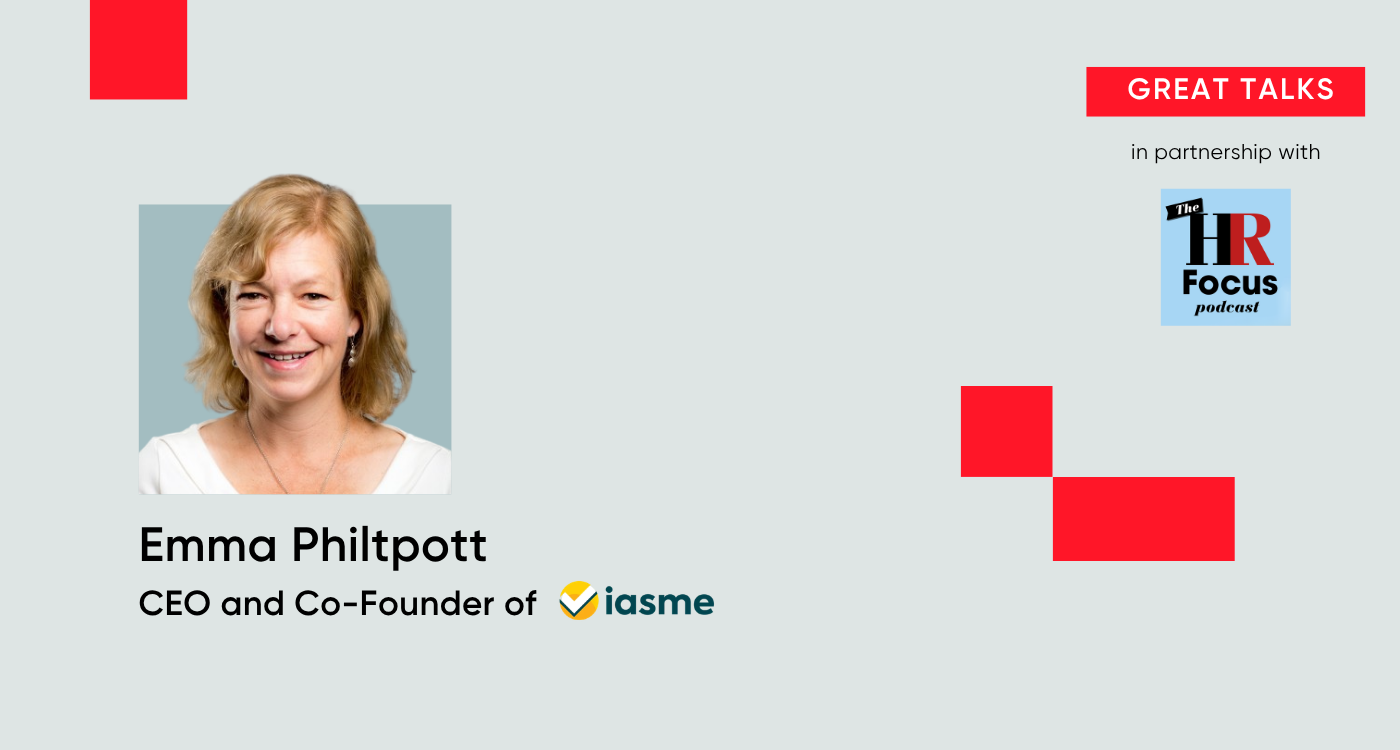



In this special episode, in partnership with HR Focus, we hear from the CEO of IASME Consortium – one of the UK's Best Workplaces™ 2026 – on how their diverse workforce and inclusive culture makes the cybersecurity company more profitable and a genuinely great place to work for all.
Key Takeaways
Dr Emma Philpott MBE, CEO and founder of IASME Consortium shares:
-
Why keeping hold of one's values is crucial amidst rapid growth and change
- Why it's important for leaders to be open about struggles or things they get wrong
- Why it's imperative to always ask, "Why not?"
-
How neurodivergent talent can be your biggest advantage in a crisis
- How to remove labels and focus on tailored support for all
- Why Great Place To Work is so much more than just a survey
Join for our For All Summit London 2026 in-person event for more inspiring insights from top-performing organisations.
Show Full Transcript
Charissa King: Hello, and welcome to this exclusive podcast episode from HR Magazine. My name is Charissa. I'm the editor of HR Magazine, and this episode is sponsored by Great Place To Work®.
The CEO I'll be speaking to shortly leads a cybersecurity firm called IASMEE, based in Worcestershire's Malvern Hills. IASMEE employs around 150 people to support more than 450 specially trained certification bodies and assured service providers. IASMEE's impactful staff team has racked up an impressive few cabinets of awards and accolades too, thanks to leaders at IASMEE. The company is a disability confident employer. It's a member of the Living Wage Scheme. It's won national cybersecurity awards, and most recently, even though it was the first time that the company had ever been assessed as part of Great Place To Work's Certification™ programme, the IASME Consortium ranked among the top 100 medium-sized organisations on the UK's Best Workplaces™ List 2026. Nearly half, that's 47%, of IASME's workforce identifies as neurodivergent, and the latest stats from Great Place To Work's Trust Index™ employee survey shows that 91% of IASME's workforce agrees that they can be themselves at work. What an accolade!
In today's interview, I'll be digging into exactly how IASME's award-winning culture was built, and specifically how developing neurodivergent talent has supercharged IASME's workplace culture for the better. I'm grateful to be joined in the studio today by IASME's CEO Emma Philpott. Welcome, Emma!
Emma Philpott: Thank you. Great to be here.
Charissa King: Thank you for joining us on the podcast today. So, if I may, I'd like to start by asking about you and your career at IASME. What was it that first attracted you to want to join the company more than a decade ago now, and what has kept you there?
Emma Philpott: So, I started the company. Actually, it was me and three people who were more academic, and we started it because at the time there was nothing for small companies to be able to show that they did good cybersecurity. So we developed something for small companies and launched it, and of course nobody cared because no one was asking for it. But it just so happened that it was alongside the UK Government also deciding that they wanted something for companies of all sizes, so we kind of overly enthusiastically threw ourselves into that, and hanging on the coat tails of that, it became Cyber Essentials. So, that we have really grown as a company with that scheme. So yeah, I was there at the beginning.
Charissa King: Wow, I'm so sorry I missed that memo! I didn't even realise that you were literally the founding member of IASME.
Emma Philpott: I have the scars, yes.
Charissa King: And you’ve come out the other side, so well done. So, no doubt, then, since founding the business, you will have seen a lot of changes to the business over the years. And what are the main ways that IASME’s culture has changed then since founding the business?
Emma Philpott: Well, it's really hard when you go from, I mean, we had two people right at the beginning, and we didn't really have any income, so we didn't pay ourselves. Up to we've now got 150, and we do pay ourselves. The culture change in that is really, really significant, and I have found that really hard as the CEO. I'm naturally somebody who likes change and chaos, and new things, and I've really had to learn how to manage in a different way as the company grows, because you can't have a company of 150 people with everyone doing change and chaos and cool, exciting things. So, I really have had to change that. And I've had to understand, in myself, all the things that I can't do, and hire people who can do them, and rely on them to do that, because I'm still not very good at sort of obeying rules and planning and structure and stuff. So yeah, it has been a big change, and I know that some of the people that were with us right at the beginning have also found that quite a big change. But with getting to be a bigger company comes other benefits. So it's kind of appreciating that as well.
Charissa King: It sounds like you've had to kind of ride that wave in order to grow the business and to meet the needs of the people that really value the service that you provide as well.
Emma Philpott: Yeah, and we get bigger and we are constantly being offered new exciting opportunities. So that's the brilliant bit. Every time we get bigger, there's more layers. There's more difficulty with communication. Also, because we're growing very fast, that's quite difficult because there's always lots of new people. And how do you keep the innovation and the values in an organisation when it's growing fast? That's something that we're very keen to keep, but we have to do it purposefully. It has to be one of our main aims, to keep our values and to keep our innovation and inclusivity. Otherwise, they'd be lost.
Charissa King: Absolutely, and I think it's one of the reasons that makes IASME a great place to work, right? It's the fact that it is actively working to keep those values and sustain it as you're rapidly expanding at the same time.
Emma Philpott: But that is also why we are rapidly expanding and why we are profitable. You know, we make profit because we're innovative and we have the most amazing people in IASME, and the reason we've got the most amazing people is because they like working for us. You know, they don't get paid the most, but they come to work because of our values and because they can be themselves, and that's what makes us successful. So, without one, we wouldn't get the other.
Charissa King: Completely agree. I think I saw you'd said in a different interview as well – I have done my research, I promise! – but you'd said to another interviewer that you don't do this to be nice. You know, being inclusive is not about being nice; it's about being profitable and making these changes that you have and embracing the kinds of people that make up your business. It's a profit-making thing. It's not to be nice, and I liked how succinct you put that in that interview.
Emma Philpott: Yeah, it's definitely not charity. We specifically look for people who have barriers to employment. Again, it's not to be a charitable, but because we know that they can make the best employees because they want to work, and if we can help them break down those barriers, which are usually irrelevant. If we can help them break down those barriers, that gives them so much more self-confidence. They want to work, and they then become the most loyal, often talented people in a company. So that's what we want.
Charissa King: Absolutely, it's a win-win, right? And on that focus on IASME and how it attracts those people who have barriers to employment: I did want to talk about the IASME Community because we're approaching 10 years now since the IASME Community was first founded in 2017, and I believe that offers some free cybersecurity training and support for adults that face barriers to employment. So, tell us a bit about that community. How does it work? How has it evolved, and how has it developed?
Emma Philpott: So it came about from my own family. My daughter crashed out of school when she was 14. Turns out she was undiagnosed autistic. So until that point, she was like the perfect daughter. She was top of her class. She had her great friends. Suddenly, she couldn't cope anymore, and it was because she'd been masking all this time. She'd been specifically learning how to be the best friend, how to be everything.
Charissa King: Bless her.
Emma Philpott: So that was a really big shock to everybody. But then I spent, I don't know, six months, a year with her, just trying to understand how she saw the world, and she trying to understand how I saw the world, and that's really what opened my eyes to all the social expectations that society has that are not made clear. If you don't make something clear, you can't expect people to do them, and it was through her she went and joined a wonderful organisation in Worcester called ASPIE, and it's a place where people with autism meet up. Adults with autism, they meet up a couple of times a week, and you'll have like 60 adults with autism just hanging out. And I went there a few times, and the thing that really struck you was, first of all, how clever they all are. Like a lot of them off-the-scale clever. But then there's a lot of anxiety and depression. But usually, because they don't have a job, most of them are unemployed. So I just thought this is ridiculous. So that is why we set up this free training course. It's over 10 weeks. It's a couple of times a week, and we have training in cybersecurity, but we also have people there to support. So there's always somebody there to help someone support. Sometimes for people just coming to a training course is like the biggest achievement of their life so far. It's a really, really big deal. If you've been self-isolated for six months, coming out and going somewhere is quite a big deal. So we recognise that we provide support, but then we also do training in cybersecurity. If people find it enjoyable and can do it, we can then offer other training courses. We're trying to join it all up so that they can eventually become employed by certification bodies as a trainee training assessor.
Charissa King: Amazing! Wow. And what kind of support do you provide in these meetups? Then do you partner with other organisations?
Emma Philpott: No. I mean, we've got quite a lot of experience in IASME now of support. We have somebody in IASME whose whole job it is just to support outside the management chain, you know, a trusted person that isn't your manager that you can go and talk to about anything, and often that person or people that have been trained in a similar way just go along and attend all the training, and talk to people and say, "Would you like me to meet you at the train station if you find it quite difficult coming here? Just being empathic and trying to just being someone that that can listen. So yeah, we do it ourselves, and often it's just having someone who is willing to talk and understand is more important than anything else.
Charissa King: Sounds incredible. How did you identify this person? I mean, the reason I'm asking you is because I'm just thinking about our audience listening to this, who might be thinking, "What a great idea! Identify someone within my organisation that can help support people who have these neurodivergent people”… Was it someone that you found who has lived experience of neurodivergence themselves. How did you go about finding them?
Emma Philpott: We've had two or three people actually in that role in IASME. The first person was the person that we developed it all with, and she used to be a special needs teacher, and her husband works in cybersecurity, and he was our CTO. So, you know, that's how you come across them. In fact, they went to the local school my kids went to, so it was really through talking to her that a lot of this kind of dawned on me. And then she left, and yeah, we just put out an advert really, and said needs to be someone that's going to have this role and has experience of understanding people, yeah, and we get wonderful people. I think that one of the most important thing is that it's outside the management chain, and they can come directly to me. The managers have got their own worries about achieving goals, making enough money, all that. These discussions shouldn't be in that discussion. They should be taken outside, and I'm the one who has the ultimate responsibility for making sure that people feel okay at work.
Charissa King: Yeah, it sounds like a big responsibility because you've got your HR team now as well, right? So hopefully they share some of that responsibility as well. Yeah, because even identifying the fact that you've got 47% of your workforce identifying as neurodivergent. People have to feel comfortable enough to share their status with you in the first place. How have you gone about working with your HR team to create that safety?
Emma Philpott: I think the most important thing is that the senior managers talk about it, not like it's a disability, but like we all have it, we all have something. So, I'm dyslexic. One of my other senior managers is autistic, and actually, we found him through this free training course for adults that had barriers to employment. He's an amazing senior manager, and we found him in that way. And he was unemployed at the time, so we just encourage all managers to talk about their experience. If you're finding something difficult, we have women managers that talk about the difficulties they're finding going through the menopause. So don't be a senior manager that's like, "Oh, I'm this manager and I'm perfect.” Senior managers have to talk about things that they get wrong. They have to admit when they get things wrong, and they have to apologise, not as some kind of big thing, but just as part of being human. So I think the more that you can do that, the more other people think, "Oh well, you know, the CEO is dyslexic, and she says it's a superpower. Of course, so I can say that I'm dyslexic,” and we just always talk about the problems that we have, not just the successes.
Charissa King: That makes sense. It's leading with intention, isn't it? It's making sure that your employees and your staff know that actually it's not a taboo subject to say that you've got this condition or that condition, or you think you might have these ways of thinking, because as has been so well documented in various research, all of this adds to the diversity of thought in in a business, which makes us more profitable and successful, right?
Emma Philpott: Yeah, and we talk about the power of hyperfocus that a lot of our autistic colleagues have. Goodness, if you need something examined, you give it to them. But then we also talk about the dangers of burnout, and in fact, we've put something in. In fact, it happened today. We've put something in. We've realised that quite a lot of our colleagues find it difficult to make time for breaks, particularly if they get in that hyperfocus zone. And so, there's now an option where you have a meeting every. I can't remember how often. Four meetings a day, I think, where it actually is a scheduled meeting, and all it is a break.
Charissa King: Oh!
Emma Philpott: Because, unless you've scheduled in those breaks, sometimes you forget. So it's just trying to always think. It's great that you're hyper focused, but what's the downside of that? And then how can we address that as a company?
Charissa King: Wow! So you've built into your employees' calendars, all of them, these breaks. Is that what you've done today?
Emma Philpott: You can opt out. Who would want to opt out the break?
Charissa King: Come on. We all need more breaks, surely!
Emma Philpott: I know, but I think the thing is, everyone is so different. So you can't have one-size fits all. I mean, we've been through so many experiences where we realise everyone's different. We have big open plan offices, lights on or off. That is a really, really hard question when you have everyone so different and some people very sensitive. We now have desk lamps on every desk and uplighters in the corridors, but it's taken a long time to get to that.
Charissa King: Absolutely! On that road, then, in your journey of how to tailor support for different employees and not do a one-size fits all approach, what have you found has worked well, and what have you found that’s taken you longer to realise? What do you wish you'd known when you started this journey?
Emma Philpott: So I think what I wish I'd known is that you cannot generalise. We ran the first 10-week course, and we hired all 14 unemployed people from that course, regardless, and we put them all in one group in a technical department. Looking back, why did we do that? We just assumed that they were all autistic. We just assumed autistic people are technical. Absolutely not. They are everything. And once we'd realised that and spread them around the company, so some of them were terribly creative. Others were really good at sort of admin. Others were good at cybersecurity. So every time we do something, I think it's just the ability to review it and change. You never do something and then you're done. You have to keep trying to improve and accept that when you do something for the best of intentions, often it will be wrong. Like when we had a dog office, we had an office for people to bring their dogs because people were anxious after coming back from COVID, they wanted their dogs. Didn't work. The dogs didn't really get on, and they would be barking, and other people would be on calls… So we don't have a dog office anymore. But that hasn't put us off trying things. I think the best way forward is to keep trying to make things better and talk about we've tried this. This is why it hasn't worked. We're going to have to stop it. And I think it's talking about things you try and things that don't work is as important as anything else.
Charissa King: Yeah, it's almost as important as the trying itself, right?
Emma Philpott: Yes. So I think another thing we've learned is that when somebody cannot do their job, or they have, well, yeah, they can't do their job, they're not meeting their expectations, or they're unhappy or stressed or anxious. There's no point in saying to them what reasonable adjustments do you want, because they don't know either. You know, they just know they want to do a good job and they can't, so we don't know and they don't know what the problem is. So it's about digging into that. What exactly is it that you're finding difficult? How can we try and change that? How can we try and adjust it? And if there's something that they find difficult, like we had an employee once who, you know, when she was feeling anxious, she wanted to sit on the floor, and of course she'd be like, "Oh, that's silly! You can't have someone sitting on the floor.” But why not? Why not? And I think always when you come up against a, “Well, you can't do that” – I want to work four days a week, but full time hours. It's like, well, you can't do that. Why not? And sometimes there's a good reason why not, but you always have to dig right in. And if you can't think of a good reason why not, you should allow it.
Charissa King: Yeah.
Emma Philpott: And I think that's what we've really learned. You can't just have a oh no, the rules say no. You really have to think: is there a good reason why not?
Charissa King: I find that so inspiring and helpful to listen to because, like you said earlier on in this interview, no one person is the same, right? We can't use a one size fits all approach. So why wouldn't we try different things? It kind of reminds me of the topic of flexibility anyway, and how more and more employees are wanting flexibility in general. HR professionals will tell you, and I think being flexible in that approach and asking the "why not" question rather than "oh, we we've always done it this way" can open up that flexibility. And it sounds like that's what's happened at IASME.
Emma Philpott: Yes, and it does make more work. It makes a lot more work for our HR department. But it's definitely worth it. It goes from can we help somebody have a good work-life balance with their kids? Can we make it so that mothers can work and look after their kids? From that all the way to this person is very anxious in work situation. How can we make it so that they can work and not be anxious? Yeah, all of it, and then you think, “Well, oh, if I let one person sit on the floor, they'll all want to”, and then it's like, but will they? Really?
Charissa King: Not everyone's the same, right?
Emma Philpott: And maybe that's okay. I think what then certainly hits me, particularly as we get to be a bigger company, is the expectation of how a company should be, and the expectation of how a CEO should be. There is a lot of societal expectation that you have to be tough, and you have to have your rules, and you have to manage people out. and There's a terrible phrase. You have to get rid of the dead wood. No, you don't. You don't have to be that person, and it's a decision. You can decide to be any kind of a CEO that you want, or any kind of a manager that you want. And yes, the company has to make money to pay the people, but you don't have to show people that you're tough, you can manage any way that you want. So, I think that's a hard thing actually for managers, particularly in as the company gets bigger, because it is a social expectation. You feel judged.
Charissa King: I'm sure that's true, and it's back to kind of what you were saying before about leaning into that vulnerable space. That you don't, you know, what I don't know the answer. You don't know the answer. Let's try and get there together. Let's lean into that awkward space of ‘I don't quite know, but it's liberating at the same time.’ And this is your rule breaker, you know, innovator coming out, Emma. I think from what you were saying – I love that, and that's why you're a founder of a successful business. It's because you do have that problem-solving, and I'm wondering if that problem-solving aspect that makes you so successful as a founder and as a business leader, anyway, is the similar kinds of qualities you find in neurodivergent people, like you were talking about with your daughter. She was having to be really creative about solving these problems that she was. I'm putting a lot on you. I know it's that may not be the case, but it sounds like she was having to really think around how to solve these problems that she was encountering every day up until the day of diagnosis. And you had said that was burdensome in terms. That's what masking is, and I wonder whether neurodivergent people, in your experience, obviously you have almost 50% of your company are neurodivergent, whether you found that that ability to solve problems is what really helps fuel your business success.
Emma Philpott: Absolutely, absolutely. But also, they're great in a crisis because their whole life has been a crisis. They turn up to a meeting in the wrong outfit. It can be a crisis. They're othered by people, and it's a crisis. They've spent their whole life working out how to carry on in a crisis. So when there's a crisis in the company, they're like, "Hell yeah, I can do this. So their resilience, in that sense of the word, is very powerful as well, as well as their innovation, and we get innovation not just from neurodivergent people, but from different backgrounds. We try and make people as different as possible, and that can be hard because, of course, everyone is so different. They're always disagreeing and always offending each other and always just trying to agree the summer party (everyone wants something different!), but I think the only way to do that is to accept it, and talk about, “You all want something different. So this is what we're going to do. If you don't want to come, that's completely fine. Don't feel like you have to come to a party because some of you won't want to.” And I think with all these issues, it is about talking about it.
Charissa King: Yeah, communication is key, right? In so many areas. I'd love to talk more about your HR department, though, and your HR leaders and your team. In what ways have they helped you in this mission to be inclusive of neurodivergent people, but of other people who are from disadvantaged backgrounds.
Emma Philpott: Well, so they are very longsuffering. There's me going, yeah. Well, let's do this, and let's do this, and let's hire all these people, and of course, we can't ask them to all obey the same rules, and they basically have to make it work, so they are amazing and very longsuffering, and I almost need them to keep the fairness because it's all very well for me saying, "Oh, that poor person, we can't expect them to work”, and they have to be the ones to say to me: “The team cannot carry a person, so we need to work out how to solve it, or it's not going to work.” So they bring all the expertise of how to make HR work, how to be fair to everybody, not just the person that I'm focusing on, and how to do that in a really fair way, you know, they are so experienced of that. But also, when I'm like, “oh, you know, it's not going to work. Let's like give up.” They're always there to say, “no, Emma, we can make it work.” So, so they play both that side. We have to have a very dynamic relationship, me and the HR department, because I'm you know, I'm chaotic and I like change and they have to try and deal with it. But then when I feel like, “oh I'm just going to give up now,” they're always there to say “no, Emma, we're going to make this work, so don't worry”. So it they kind of have to play both those sides.
Charissa King: It sounds like CEOs can be a pain, but so can we all, right? We have to have that working relationship of support either way, whether it's through the good weather and the bad, anyway, right?
Emma Philpott: Exactly, exactly, and it's, you know, they have to deal with the formal policies. It's all very well for me saying, “I know, let's do this because that's going to be good for everyone”, and they're like, "Oh my gosh!
Charissa King: Yeah, I'm with you. I'm with you. So yeah, well done, HR. Keep going.
Emma Philpott: We specifically also recruit people with long-term health problems because I've realised that there's people who have things like MS and Crohn's disease who will be fine for months and be the best worker, and then suddenly they'll be off sick or even in hospital for weeks, sometimes months, and because of that, they find it really hard to keep a job. And some of these people can be, except for that, healthy young people, and they find it difficult to keep friendships, and they keep find it difficult to keep a job. It's outrageous. So all you need to do is identify roles where that's okay, that they can suddenly be off for a week or two. So because of that, we have roles like that, and we have people who have long term health problems, who are amazing? They really, really amazing. But then it's up to HR to make that work as well, and to make sure that they're safe in IASME as well.
Charissa King: So yeah, it's that partnership.
Emma Philpott: Yeah, I put a lot on our HR department, and they're brilliant.
Charissa King: Look, you won't be the first and last CEO to do the same. Trust me, you'll be fine. That's great. I love the sound of that. Keep doing what you're doing. Back to the neurodivergent category, those neurodivergent staff in your organisation. Thinking back to all these different strategies that you've employed to support these people, what are the most important things to bear in mind? Would you say to anyone listening who wants to support their neurodivergent staff more, what should they bear in mind when creating a strategy for supporting neurodivergent staff?
Emma Philpott: So, I mentioned before, don't expect them to know the solution. Just because you're neurodivergent doesn't mean to say you know what reasonable adjustments you want. Most staff will not know they're neurodivergent, so they will be having problems with something, and you'll be like, "Oh, I've seen this before, but they won't know that it's a neurodivergent quality. They won't know what to do about it. They're just struggling, so you can't expect them to say, "I'm neurodivergent, and this is what you got to do about it”. A lot of organisations will employ a lot of neurodivergent people already, and maybe those people are having problems, and the organisation and the person don't know. So it is just about listening. If someone can't do something, assume that they want to. You know, don't assume that someone's not doing a job because they don't want to do a job. I've found almost everyone wants to do a good job, and if they're not doing a good job, it's because of an issue. So then dig into what that is and try and work out a way of solving it.
Charissa King: That makes total sense to me, and it also answers my next question, which was no, it's great. I love when interviewees do this. I was going to ask you what preconceptions should go out of the window, and you've kind of named one of those, which is they don't have the answers. And it's so interesting you brought up this idea of diagnosis, in my view, because I often see across my desk stories that come to me about neurodivergent people and queries to do with how we identify those people because there are people who don't have a formal diagnosis and there's a lot to go through to get a formal diagnosis for some of these conditions, right? Yeah. How do you cope with that in IASME?
Emma Philpott: So we've moved completely away from labelling people. People have an anxiety, or they have a need, or there is a barrier, and it might be because they're neurodivergent. It might be because they had a trauma earlier in life. Might be that their husbands just left them. It can be all sorts of things. So all we see is this issue has come up. How can we help them address it? Sometimes, because of work, he and I as me, and we go on about it so much, people will realise that they're neurodivergent. It's like, oh my gosh, I'm neurodivergent, and it's more for them that they sometimes want to go and get their diagnosis and want to look at the various options that they could go for. For us, it's irrelevant. If someone is neurodivergent or not, it's completely irrelevant. Sometimes knowing that you are of a certain neurodiversity can help you because you'll then read books about it and be like, oh, all these other people have had similar lived experiences to me, and that can be really supportive. But it's more for the individual to know about it. For us, it's just this person has got a barrier. How can we deal with it?
Charissa King: Fascinating. So, ditch the labels is one of the pieces of advice because my next question was going to be, what should HR leaders not worry about when trying to better support neurodiverse employees? And it sounds like the answer is you don't necessarily have to worry about the labels. Oh, okay, we've now got this label. What's the advice about how to deal with that person? It sounds like you're saying park that for the moment. Is that what you're saying?
Emma Philpott: Yeah, definitely. And even in the law, if somebody is neurodivergent and you suspect them of being neurodivergent, you legally have to protect that employee, whether they know it or not. And I think I would take that. I know that's the law, but from our point of view, that goes wider. If anyone has got a barrier of something, whether they tell you about it or not, we have a responsibility to try and help them work that out.
Charissa King: Yeah, as forward-thinking employers, we want to make sure that we're doing the best for our people. So, yeah, you are setting a great example for that.
Emma Philpott: But also, I mean, it's selfish as well. I want all my employees to be happy and motivated and bought into the company values. People love the company values. I've even had people come to me and saying, "I want to work for your company, and I've said, "Yeah, we can't afford you”, and they say, "No, I want to come on a pay cut”. I can't believe it, but they actually do because they reach a stage in their life where they want to work for an organisation that they can believe in. And I think for me, I was always the strong one. I didn't need any help. I didn't need any support until my daughter had a breakdown, and then my gosh, I needed everyone's support. I was completely vulnerable, and my team looked after me, and in IASME, that's what you get. You can be the strong one, but hopefully, everyone in IASME knows that if you're not strong, if you come up against a barrier, if you need extra support, you will be supported.
Charissa King: It's so important for people to know that, and it definitely looks like from the statistics that your employees know that, so well done. You're doing great work over there. It just it sounds like there's so much to be proud of about IASME's culture. So I have to ask that question. You know, if you had to pick one, what are you most proud of in relation to your culture?
Emma Philpott: Oh my goodness. Well, I'm most proud that people can be themselves. I mean that is the ultimate aim, but I want everyone to be themselves. You look at it; there's not 100% I want absolutely everyone to feel they can come and be themselves, whatever they want to wear, whatever they want to do, whoever they want to be. Then they should be able to be it.
Charissa King: Absolutely. And how are you looking to enable that going forward? What's in the next plan, what's the next stage of the plan?
Emma Philpott: Well, I mean, it's just constant in terms of everyone we come across probably has a new insight into potential barriers, and like the thing that came out today, where you have a formal meeting four times a day or however many times a day to help people take a break, and I think it's a case of, you know, you never reach the end in trying to be more inclusive. You can always do a lot more. There's lots of areas that we need to do a lot more, and I think it's just yeah you just have to keep going.
Charissa King: Absolutely, encouragement for us all. Thank you so much, Emma. Just bringing you back quickly to the Great Place To Work Certification™. So, I know you're new to this certification, but I just wondered whether you could share anything about the impact that being on a Great Place To Work List has had on the organisation.
Emma Philpott: So, it's wonderful. It's somebody from the outside saying, “you're a great place to work. And people can be themselves in your organisation,” so that is really, really reassuring and wonderful. And of course, for our image, it's brilliant. But what I hadn't realised: so I thought that that was it, you know, they do a survey, you'd be on a list, and everyone would go “Yay!”. But actually, it's so much more than that. So, the survey is confidential, and you get so much detail. So we can see, if you look at like senior managers, middle managers, sort of frontline staff, you can see the variation of who's feeling happy, who's feeling appreciated, who's feeling like they can be themselves, who feels like they've got enough responsibility. All of it you can see in so much detail without it being individuals, that it's allowed us to put together a really good plan to deal with any issues. You know, every company has got issues. We can all do much better, and yeah, and so the data that we got out of it, and also the fact that Great Place To Work see this across so many organisations, they talk us through it, and we were always like, "Oh no, pay is going to be really bad. And they say, "Oh, don't worry, no one's happy about pay, and you've done fine.”
Charissa King: So it's having, being able to benchmark yourself against other organisations.
Emma Philpott: Exactly. So that was immensely valuable, and I hadn't even realised that it was going to be like that. So yes, really good.
Charissa King: Oh, I'm so glad to hear that. That's brilliant. Last thoughts, then, really. I've got to the end of my questions. What else would you like to say about inclusivity, and also, what tips do you have for HR leaders to keep inclusive workplaces on the agenda at the C-Suite level, because it is hard for some diversity and inclusion leaders at the moment. There is a lot of backlash against inclusivity programmes. What advice do you have for HR leaders that are navigating this space right now?
Emma Philpott: So, it's about reducing barriers so you can get the best people. That's what inclusivity is about. It's not about trying to make numbers or fulfil percentages. You just want the best people. But sometimes it's not as simple as saying, "Well, we didn't have any women apply”, because some of the issues go a lot deeper. So it's trying to find out what the issues really are, and digging really into the barriers and addressing them, but don't do it for the numbers and don't do it to be nice. Do it because you will make more money, and that's where the C-suite will be interested. I mean, honestly, you become way more profitable, and it's a joy to see that money rolling in based on making something into a great place to work. And it starts from the conversations you have to talk about issues and failures and problems that senior managers have had personally before people will be comfortable in sharing their problems with you.
Charissa King: It's about being curious, it sounds like as well. And it's like, I do hear it time and time again in business conversations, “But keep that curiosity up”. Why is there that barrier? Who is there? Maybe you know, with or without a label of what the issue might be medically. What is that barrier? How can we reduce it?
Emma Philpott: Yes, exactly. And you need different people. Otherwise, you all think in the same way, and you just come up with the same thing over and over again.
Charissa King : We've seen the dangers of echo chambers time and time again. No, I completely agree with that. Huge thanks for your time and your insights today, Emma.
Emma Philpott: Thank you. I've really enjoyed it.
Charissa King: Really appreciate having you. Thank you for listening to HR Focus, and thanks again to our sponsor, Great Place To Work UK. If you like what you're hearing, check out our sister podcast, the HR Most Influential Podcast, where we explore the interests and ideas of HR's top practitioners and thinkers. And if you're after a daily dose of HR news, visit hrmagazine.co.uk.


 Podcast