


- High-trust cultures are 5.3X more innovative than low-trust cultures.
- The Great Place To Work Effect links trust to innovation and performance.
- Everyday leadership behaviors build trust and enable innovation.
Innovation is a priority for nearly every organisation. But for many leaders, it still feels frustratingly slow.
Despite investment in technology, transformation programmes and new ways of working, innovation often stalls – not because people lack ideas, but because the conditions for innovation aren’t there.
Our research shows the missing ingredient is simple: trust.
This article is part of our Great Place To Work Effect series, exploring how trust directly drives performance outcomes – from innovation and agility to productivity and retention.
What is the Great Place To Work Effect?
The Great Place To Work Effect is a proven link between trust and business performance. Across millions of employee survey responses globally, Great Place To Work has consistently found a repeatable pattern: great leaders build trust, which shapes the culture that drives performance.
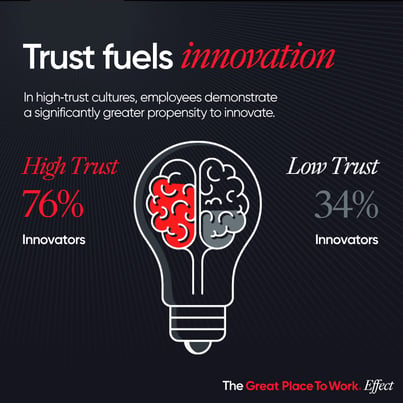
High‑trust organisations consistently surpass their peers across business metrics, including innovation. In fact, high-trust workplaces are 5.3X more innovative than their low-trust counterparts.
Because of this, our research consistently shows that the UK’s Best Workplaces outperform the market by more than four times and achieve 6.25 times greater revenue per employee than typical UK organisations.
| Useful Read: The Great Place To Work Effect
What does innovation look like in practice?
In high‑performing organisations, innovation isn’t owned by a single team or function. It’s built into how people work every day, fostering a culture of continuous improvement.
Leaders actively invite ideas, ensure they are heard, and recognise contributions – reinforcing the belief that innovation is everyone’s responsibility.
This mindset changes innovation from something episodic into something constant: a shared capability across the organisation.
| Discover How Development Drives Performance
Why trust drives innovation
Innovation requires more than ideas. It requires an environment where people feel able to use them.
When people feel safe to experiment without fear and believe their ideas will be valued, they are more willing to take thoughtful risks and contribute fresh thinking.
By contrast, low-trust environments inhibit innovation by fostering caution, disengagement and a reluctance to voice unconventional thinking, ultimately constraining their own development and business progress.
The evidence is clear: high‑trust cultures breed innovation. When trust is high, employees demonstrate a significantly greater propensity to innovate.
| Useful Read: How Kia UK’s Culture Of Innovation Is Powered By A Great Employee Experience
How leaders can drive innovation by building trust
Building a high-trust environment that fosters innovation starts with everyday leadership behaviours.
Leaders who successfully unlock innovation tend to:
-
Make it safe to speak up: They actively encourage different perspectives and respond constructively, even when ideas challenge existing thinking.
-
Recognise effort as well as outcomes: Innovation involves risk. Leaders should reward learning, experimentation and initiative – not just successful results.
-
Embed development as a daily behaviour: high‑trust leaders treat development as a daily leadership behaviour, not confined to formal programmes.
-
Create a sense of shared ownership: Innovation becomes stronger when everyone feels responsible for improving how the organisation works.
These behaviours may seem simple, but consistently applied, they transform how people act – and how organisations perform.
As the Great Place To Work Effect shows, trust fuels the culture that enables innovation, and long‑term business success.








 employee experience